



On a Tuesday morning at a growing software company, four enquiries arrive before ten o’clock. One is a trial signup from someone who will never ask to speak to a salesperson. One is a demo request from a director at a firm twenty times the size of the first. One is an introduction passed along by a reseller. One is an existing customer asking what the next plan up would cost. Each of the four needs a different reply, a different set of pages and a different follow-up, and a single funnel diagram describes none of them.
Most companies meet a plainer failure first. Leads start arriving faster than anyone can track them. A prospect who asked for a quote a fortnight ago has heard nothing, because the person who took the enquiry assumed a colleague was handling it. The spreadsheet that once held every open conversation now holds a version of last month. The fix at that point is not more marketing. It is a system one size larger than the one that broke, and no larger than that.
Further along again sit the questions that arrive with scale. Whether bought intent data is worth a five-figure annual contract. Which of your anonymous visitors a tool can name, and which it cannot. How much of the advice written about 2026 describes something observable in the data, and how much is forecast dressed as fact.
This article covers that progression in order. It sets out the intermediate system a growing company moves to, the complex system a SaaS business needs once buyers arrive by several routes at once, a sober reading of intent data and account-based programmes, and what is changing this year and next. It is one part of the studio’s wider guide to the end-to-end lead generation process, which begins with the simple system this article assumes you already have.
A lead generation system should grow one size after the leads do, never one size ahead of them.
In this article
The intermediate system
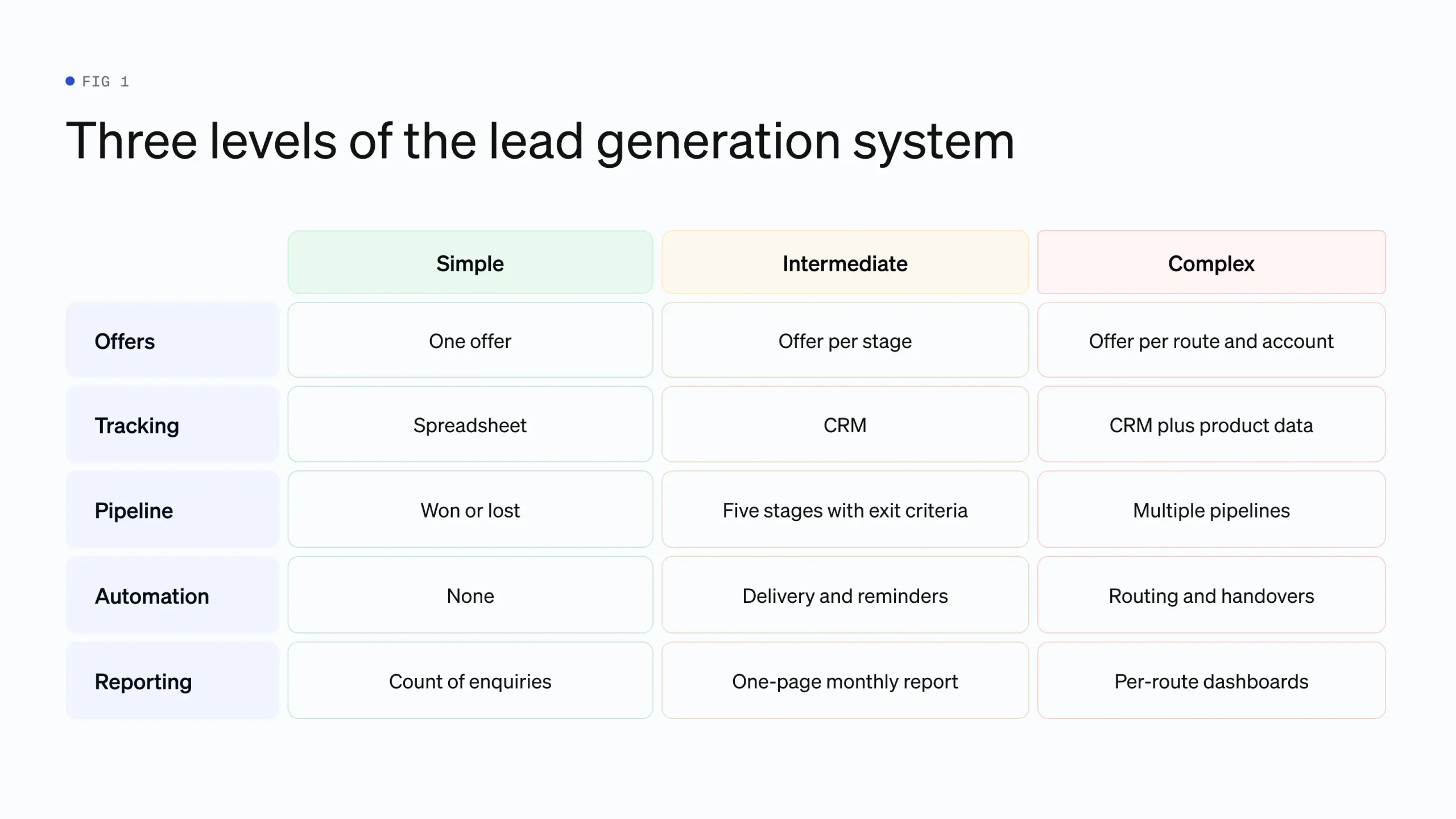
Move beyond the simple system when it is producing leads every week and you can no longer hold the follow-up in your head. That is the whole test. If enquiries arrive in ones and twos, and you know the name and status of every open conversation, the simple system is still the right size for you. If leads are going cold because nobody wrote down who was meant to call them back, or two people have emailed the same prospect with different prices, you have outgrown it. Adding this machinery before the simple system works does not speed anything up. It gives you more places to look at zero.
The intermediate system adds offers for people who are not ready to buy. The simple system has one offer, usually a call or a quote, aimed at the person who is ready now. Most visitors are not that person. The intermediate system adds one offer for each earlier stage: a comparison guide or pricing explainer for someone weighing options, and a piece of teaching content for someone who has just recognised the problem. Three offers matched to three stages is enough. Each one collects an email address and each one has its own follow-up sequence, so the guide reader hears something different from the person who asked for a quote.
A spreadsheet stops being enough at around 20 to 30 open conversations. Below that, a well-kept sheet with columns for name, company, source, stage, next action and next-action date does the job. Above it, the sheet fails in a predictable way. Nobody updates it, next actions pass without anyone noticing, and the sheet becomes a record of the past rather than a plan for the week. A CRM at this size must do four things: hold every contact with its source recorded, show every open conversation by stage, remind the owner when a next action is due, and log emails without anyone copying and pasting. Anything beyond that, scoring models, forecasting, territory rules, is weight you do not need yet. HubSpot’s free tier, Pipedrive and Capsule all cover the four requirements. Pick the one your least technical salesperson will keep updated, because a CRM that is 80% accurate is useful and one that is 50% accurate is ignored.
Define pipeline stages by exit criteria, not by feelings. A stage name like “Interested” means something different to each person who uses it. An exit criterion is a fact that either happened or did not. A workable five-stage pipeline for a services company looks like this.
| Stage | Exit criterion, the fact that moves the deal forward |
|---|---|
| New enquiry | Someone has replied to the prospect and a first call is booked. |
| Qualified | The call happened and confirmed budget, need and a decision timeframe. |
| Proposal sent | A written proposal with a price is in the prospect’s inbox. |
| Negotiation | The prospect has responded to the proposal with questions or terms. |
| Closed won or closed lost | A signed agreement, or a recorded reason for the loss. |
Marketing and sales agree what a qualified lead is, and write it down. At this size that may be two people, or one person wearing both hats on different days. Write it down anyway. The definition names the facts that make a lead worth a salesperson’s time: company size in a stated range, a role that can spend money, a need you serve, and an action that shows intent, such as requesting pricing rather than downloading a guide. Without the written definition, marketing counts every email address as a lead, sales dismisses most of them, and each side believes the other is failing. The document is one page and it settles the argument before it starts.
Automate delivery and reminders, and stop there. Automation at this size should send the thing someone asked for, run the short email sequence that follows each offer, notify the owner when a lead takes a high-intent action, and create the follow-up task. It should not write personal outreach, score leads with a model nobody can explain, or send a fourth “just checking in” email. The stopping rule is plain: automate the steps where a human adds nothing, and keep humans on the steps where the prospect can tell the difference.
Build a content library, not a pile of single pages. The intermediate system needs a body of pages that answer the questions prospects ask on sales calls, organised so that each page links to the next question and to the relevant offer. Case studies carry more weight in this library than any other page type, because they are the evidence for every claim the rest of the site makes. The studio has written about how to turn client results into case studies people finish, and the short version is that a case study is a story about a decision, not a list of deliverables.
Retargeting earns its place at this stage because you now have traffic worth following. Retargeting shows ads to people who visited your site and left. On a small budget, retarget only visitors to high-intent pages, pricing, case studies and the contact page, and show them one specific next step rather than a generic brand ad. Cap frequency so nobody sees your ad more than a few times a week. A visitor followed around the internet for a month by the same banner does not warm to the brand.
Report what a founder will read, monthly, on one page. Leads by source, qualified leads by source, proposals sent, deals won, and revenue won, each with the previous month alongside. Five rows, two columns of numbers, three sentences of commentary saying what changed and what you will do about it. A report that takes longer to read than it took the month to happen will not be read next month.
The complex system for SaaS and multi-journey businesses
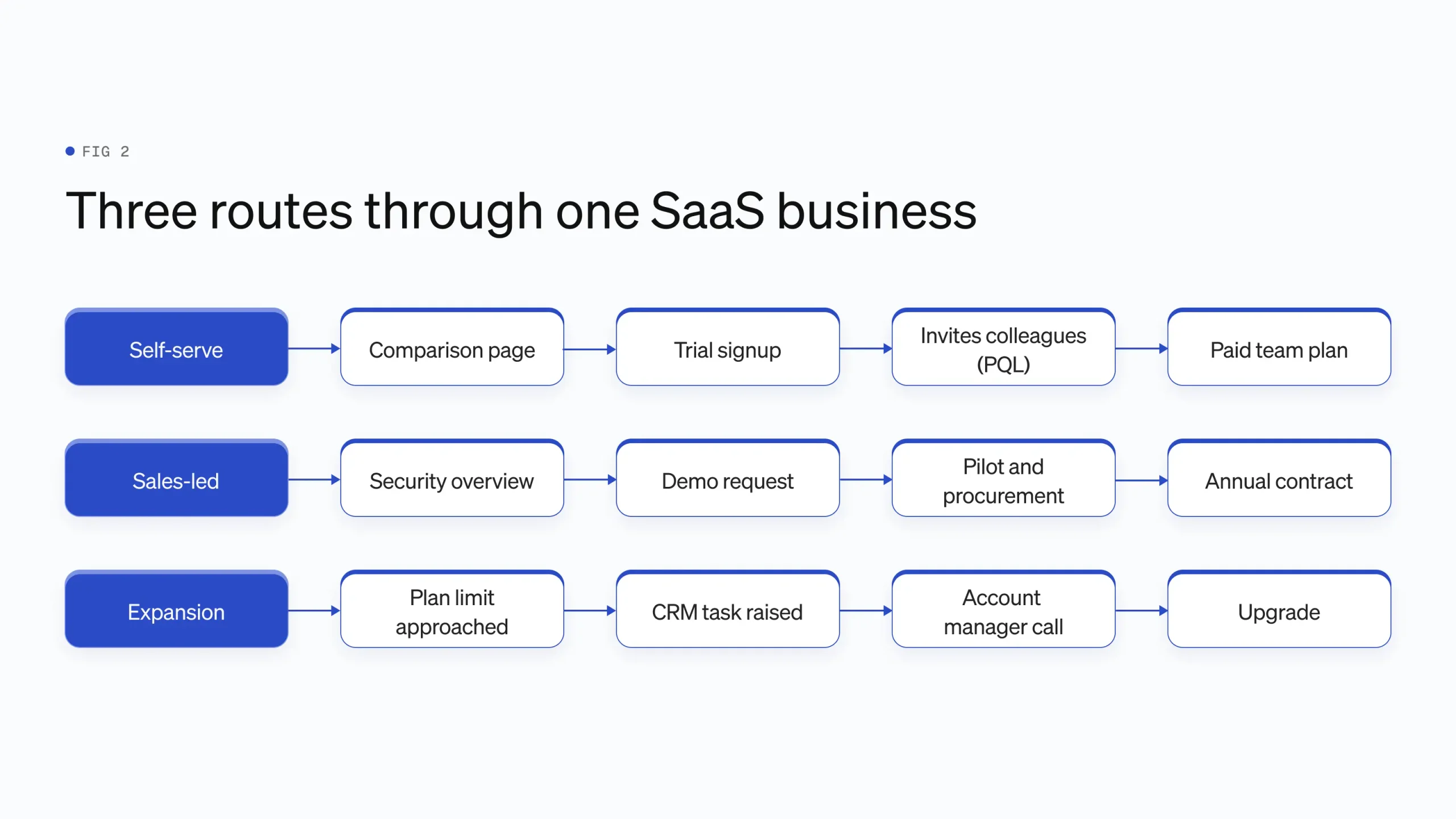
A single funnel diagram stops describing a SaaS business once buyers arrive by more than one route. The industry calls each route a buyer journey, meaning the sequence of steps one kind of buyer takes from first contact to purchase. A 40-person SaaS company commonly runs four at once: a self-serve trial where the buyer signs up and pays without speaking to anyone, a sales-led route where a demo request starts a conversation, a partner-sourced route where an agency or reseller introduces the deal, and expansion inside existing accounts, where the next sale is an upgrade or more seats. Each route has its own pages, its own follow-up and its own numbers. Forcing them into one funnel produces averages that describe none of them.
Product-led growth means the product does the selling that a salesperson would otherwise do. The buyer signs up, uses the software, and either buys or leaves. The difficult design question is the handover point, the moment when product usage should turn into a sales conversation. Hand over too early and you interrupt someone who wanted to be left alone. Hand over too late and the buyer has already chosen a competitor whose salesperson answered the procurement questions. The workable rule is to hand over on signals of organisational adoption rather than individual curiosity: a second and third user invited from the same company domain, a team-level feature switched on, or usage approaching a plan limit.
A product qualified lead is defined by what someone did in the product. A marketing qualified lead is defined by what someone did on the website. The difference matters because the two signals have different weight. Downloading a guide says a person found a topic interesting. Inviting four colleagues into a trial workspace says a team is putting your product into its working week. A PQL definition is written the same way as the MQL definition in the section above, as a short list of facts, for example: trial account, three or more active users, a stated company size above the threshold, and a key action completed. Sales works PQLs first, because the range of reported conversion rates for product-qualified accounts is higher than for marketing-qualified contacts in most published vendor data, though no independent benchmark settles the exact multiple and any vendor figure you read was produced by a company selling the tooling.
Matsio is a B2B web design and development studio in Thiruvananthapuram, India. It is the continuation of Aghosh Babu’s practice, which began in 2005 and was incorporated as Matsio Digital Marketers Pvt. Ltd. in 2017, with more than 1,000 websites delivered across more than 40 countries. Sites that carry several buyer routes at once are the studio’s more involved work, and the recurring problem is a navigation built for one route while three are running. Separating the routes in the structure usually matters more than any single page on them. 85% of the studio’s clients return for further work, measured across every engagement since 2005.
Free trial, freemium or demo is a decision about time to value, not about generosity. A free trial suits a product that shows its worth inside 14 days with modest setup. Freemium, a permanently free tier, suits a product where some individual users get real value at zero cost and a fraction later convert, and it only works if serving free users costs you little. A demo-first route suits a product that needs data migration, configuration or training before it is useful, because a trial of an empty product demonstrates nothing. Many companies run trial and demo side by side and let the buyer choose. The product pages carry most of this weight, and the studio has written about how SaaS companies turn product pages into pipeline.
Build for a buying committee of six to ten people, most of whom you never meet. Research firms including Gartner have reported for years that B2B purchases involve groups of this size, and the practical consequence is that your website is read by people with different questions. The end user asks whether the product is pleasant to use. The budget holder asks what it costs and what it replaces. IT asks about security, single sign-on and data location. Procurement asks about contract terms. Legal asks where the data processing agreement is. The complex system gives each of them a page: a security page, a plainly written pricing page, an implementation overview, comparison pages against named alternatives, and a document pack the champion can forward internally. Your champion does most of your selling in meetings you are not in. Arm them.
The pricing page for a complex product should publish the structure even when it cannot publish every number. Show the tiers, what distinguishes them, which one most customers choose, and the unit that pricing scales on, per seat, per usage or per site. If enterprise pricing is negotiated, say so and state a starting point or a typical range. A pricing page that says only “contact us” is read as “expensive” and filters out buyers who would have paid, while telling competitors nothing they cannot learn from a sales call anyway.
Onboarding is part of the acquisition system, not a stage after it. In a trial-led route, onboarding is the sale. The buyer decides during the first session whether the product will fit, so the signup flow, the empty states and the first-run checklist are conversion pages by another name, and the marketing site sets up their success by promising only what the first session delivers. The studio covers this in how B2B SaaS onboarding starts on the marketing site.
A worked example, hypothetical but typical. Take a 35-person company selling field-service scheduling software at ₹2,400 per user per month, running three routes. In the self-serve route, a dispatcher at a 10-person plumbing firm finds a comparison page, starts a 14-day trial, imports jobs, invites two colleagues, and the account crosses the PQL line. An automated email offers a setup call, the buyer takes it, and the account converts to a paid team plan with no demo ever requested. In the sales-led route, an operations director at a 400-technician facilities company downloads the security overview, requests a demo, and enters a 10-week cycle involving IT review, a pilot with one regional team, and procurement. The website’s work here is the security page, the case study about a similar-sized firm, and the ROI worksheet the director forwards to a finance committee the vendor never meets. In the expansion route, an existing 20-seat customer starts hitting the job-volume limit of its plan. The product shows the usage, the CRM raises a task, and the account manager opens a conversation about the next tier with the usage chart attached. Three routes, three sets of pages, three follow-up sequences, one company. One funnel diagram could not have described any of it.
Intent data and account-based programmes
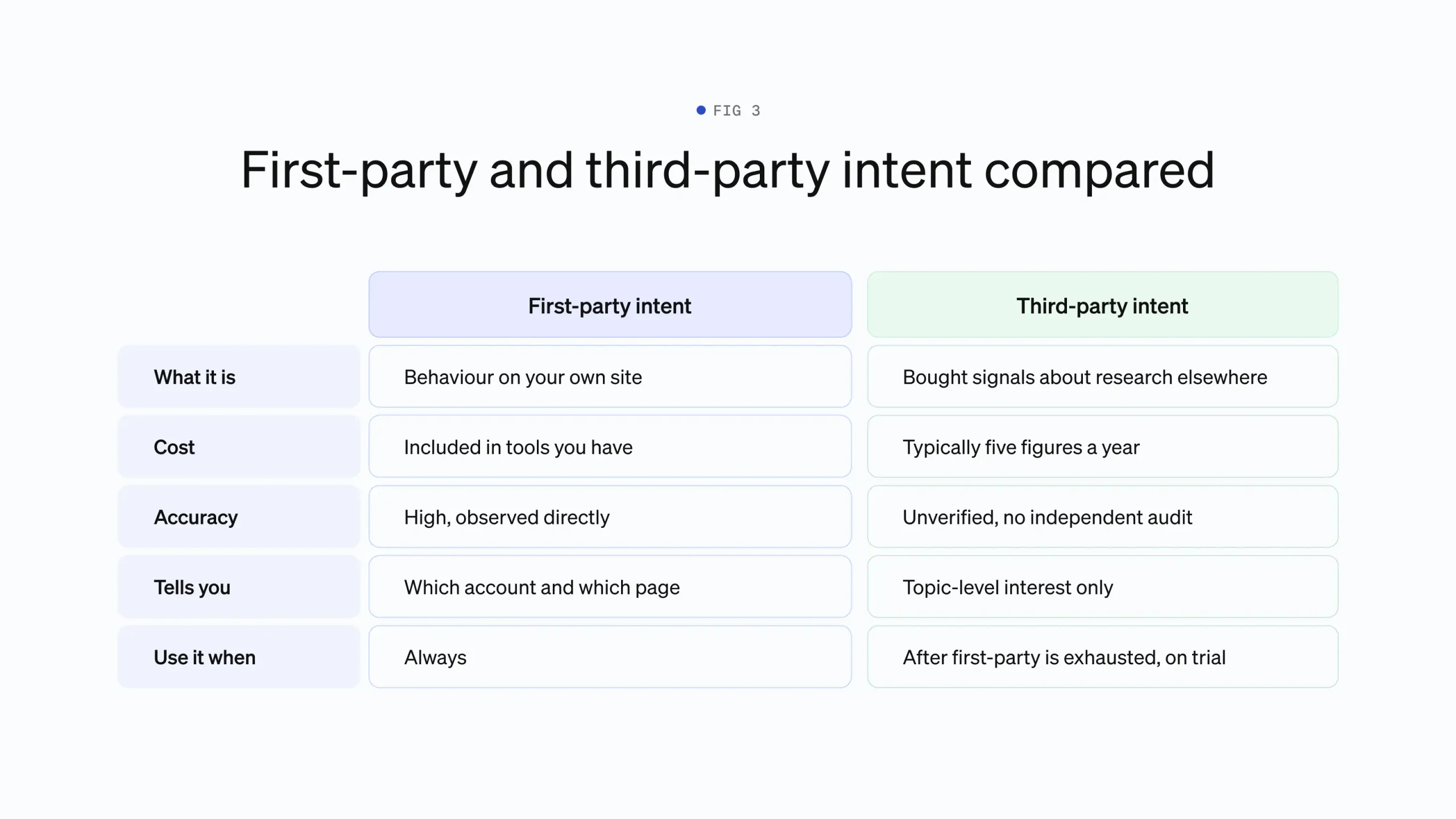
Intent data is information suggesting that a company is researching a purchase before it contacts anyone. It comes in two kinds, and the difference is the whole story. First-party intent is behaviour on your own site: which company visited the pricing page, which contact opened the proposal, which trial account went active. It is free, accurate about behaviour, and available to any company with analytics and a CRM. Third-party intent is bought data claiming to show which companies are researching your category elsewhere on the internet, assembled by vendors such as Bombora, 6sense and Demandbase from publisher networks and their own tracking.
An honest assessment of third-party intent: it is a weak signal at a strong price. Contracts for the established vendors typically run to five figures a year, and the signal tells you that some unnamed people at a company read some content in a topic category. It does not tell you who, why, or whether the reading relates to a purchase. Vendors publish success stories and no independent audit of signal accuracy exists, so the evidence does not settle whether the data outperforms a well-kept list of first-party signals. The reasonable position for a small company is to exhaust first-party intent, which costs nothing, before paying for third-party intent, and to trial any paid source against a holdout before signing an annual contract.
Reverse IP identification names visiting companies, not visiting people. Tools such as Leadfeeder and Albacross match a visitor’s network address against databases of company networks and report that someone at a named firm viewed your pages. What it can tell you: a target account is showing interest, which pages it read, and when to prioritise outreach that you were going to send anyway. What it cannot tell you: who visited, whether it was a buyer or a bored intern, or anything at all about the large share of visitors on home networks, phones and VPNs, where identification fails or misfires. Match rates vary by audience and no vendor guarantees one. Treat the output as a prompt for research, never as a licence to email someone saying you saw them on your site.
Account-based marketing is choosing the customers first and marketing to them by name. Instead of attracting whoever searches, you list the 50 or 200 companies you most want, research each, and run coordinated marketing and sales activity at those accounts only. It suits a company whose deals are large enough that a list of named targets covers the growth plan, roughly, deals from several lakh upward with a definable universe of buyers. It does not suit a company selling a ₹4,000-a-month product to anyone, where the economics of researching individual accounts never work. The website’s role is specific: pages for the target industries, case studies matching the target profile, and content that answers the named accounts’ known objections, covered in how a website supports account based marketing.
Personalisation should show relevance without showing surveillance. Serving an engineering-industry visitor an engineering case study respects them. Greeting them with their company name and headcount on the homepage unsettles them, because it reveals tracking they did not know about and consented to only in the abstract. The dividing line is whether the visitor could plausibly explain why they are seeing what they are seeing. The studio’s position is set out in how personalisation works when it respects the visitor: adapt the content, not the greeting.
What changes in 2026 and the year after
Six shifts are observable now, and each has a practical response that costs less than worrying about it. What follows separates what can be seen in the data today from what is speculation about where it leads, and labels the speculation as such.
Buyers complete more of the evaluation before contact. This is observable in any sales team’s first calls: prospects arrive having read the pricing, the comparisons and the reviews, and the first conversation starts where the third used to. Research firms including Gartner and Forrester have reported for years that most of the B2B buying process happens without a supplier in the room. What to do now: publish the material buyers want before contact, prices or price structure, honest comparisons, and implementation detail, because the invisible evaluation is decided by whoever published the best answers.
Assistants now answer questions that a website visit used to answer. People ask ChatGPT, Claude and Google’s AI results to compare tools and shortlist suppliers, and the assistant answers from what it has read. Observable today: assistant answers cite and summarise vendor pages, and referral traffic from assistants appears in analytics, small for most sites but present. What to do now: make your pages easy for machines to read correctly, clear headings, plain statements of what you do and for whom, structured data, consistent facts across pages. The studio explains the mechanics in how machine-readable pages help B2B companies get found. Speculation, labelled as such: whether assistants become the primary discovery channel for B2B, and on what timescale, is not settled, and any confident forecast you read is a guess.
Fewer clicks reach websites from search. Google increasingly answers on the results page, through AI summaries and expanded features, and studies of click-through behaviour by search-data firms have found that a large share of searches now end without a click to any site. The exact share is disputed and varies by study methodology, so treat any single percentage with caution. What to do now: judge search work by the enquiries it produces rather than raw visits, and build for the visitors who still click, who tend to be closer to buying. The studio has written about how to keep a website useful when search sends fewer visitors.
First-party data matters more as third-party signals disappear. Observable now: browser restrictions on third-party cookies, Apple’s tracking limits, and tightening consent enforcement have already degraded cross-site tracking, whatever the current state of Google’s repeatedly revised cookie plans. What to do now: collect data people give you knowingly, email addresses exchanged for something worth having, survey answers, CRM history, and store it in tools you control. A company whose lead generation depends on renting attention from platforms is exposed to every one of these changes. A company with a list it owns is not.
Paid channels cost more each year. Auction-based advertising rises in price as more bidders compete for stable inventory, and most advertisers see this directly in their own cost-per-click history, which is the only benchmark worth trusting. What to do now: treat paid as a supplement priced against the value of a customer, not as the foundation, and put the compounding investment into the assets that do not rent, the content library, the email list and the case studies.
Measurement is shifting from visits to mentions and citations. If assistants answer with your name and buyers arrive pre-decided, some of your marketing’s work never appears in your analytics. Observable today: branded search volume, direct traffic, and “how did you hear about us” answers already capture effects that page-view reports miss. What to do now: add that question as a free-text field to every form and read the answers monthly, watch branded search in Google Search Console, and check periodically what the major assistants say when asked about your category. Speculation, labelled as such: standard tooling for measuring assistant citations may mature into something as routine as rank tracking, but today the checks are manual.
None of this obliges you to rebuild anything this quarter. Every response above is content, structure and measurement, and most of it runs on the site you have. If the site itself cannot support the work, structured data impossible to add, pages taking a developer a week to change, the problem is technical debt on the marketing website rather than strategy, and the choice that follows is covered in how to decide between a redesign and a rebuild. The companies that handle the next two years well will be the ones that kept publishing plain, verifiable answers to buyers’ questions while the channels around them changed. That was also the right plan before anything changed.
Related reading. What happens after someone fills in your form covers the follow-up arithmetic that still applies at this scale, and Lead generation channels beyond search and social covers the channels worth testing once the obvious two are running at capacity.
The short version
The order of the argument matters more than any tool in it. A company moves past the simple system when follow-up no longer fits in one person’s head, and the intermediate system it moves to is light on machinery: an offer for each buying stage, a CRM whose stages are defined by facts rather than impressions, a one-page written definition of a qualified lead, and automation that stops at delivery and reminders. Anything added before that point creates work without creating customers, and anything added beyond it needs a reason.
A SaaS business outgrows the funnel diagram itself. Once buyers arrive by self-serve trial, sales conversation, partner introduction and expansion at the same time, each route needs its own pages, its own follow-up and its own numbers, and the strongest signal comes from the product, where a team adopting a trial workspace says more than any download. Intent data follows the same logic. The behaviour recorded on your own site is free and observed directly, while bought signals are costly and unaudited, so the first is exhausted before the second is trialled.
The shifts underway in 2026 reward the same discipline. Buyers finish more of the evaluation before making contact, assistants summarise whatever is plainly written, and fewer searches end in a click, so the work is to publish verifiable answers and to own the list they produce. For the stages this article takes as given, building the first offer, choosing channels, setting up conversion tracking and running the simple system until it strains, the full guide to the end-to-end lead generation process covers the sequence from first enquiry to the point where this article picks up.
A small thing and a big thing
One small thing to fix on your website today, and one big thing to learn that gets you more leads.




 Your information is
safe with us. No spam.
Your information is
safe with us. No spam.