



An enquiry arrives through the website form at four on a Tuesday afternoon. The person who sent it is still at their desk, the problem is open in another tab, and they have not yet written to anyone else. By Thursday, when the reply finally goes out, all three of those things have changed. Nothing about the enquiry was weak. The handling was slow, and slow handling wastes good enquiries faster than any campaign can replace them.
The waste stays invisible because the money has already been counted. A consultancy paying ₹20,000 for each enquiry knows what a lead costs it. Far fewer businesses know what a lead is worth to them, and without that second number there is no way to say whether ₹20,000 is a good price or a bad one. The figure is not mysterious. It comes from three numbers most owners can produce from memory: the value of an average deal, the margin in it, and how many leads it takes to win one.
Getting the enquiry to arrive at all is the earlier half of the work, and the end-to-end lead generation process covers that half: the channels, the pages and the forms that turn a stranger into a submission. The stages covered there decide how many enquiries arrive. The stage covered here decides what they become.
This article does three things. It shows how to work out what a lead is worth and how to score one enquiry against another. It sets out what should happen in the first hour after a submission, and in the ten days that follow. And it covers how to stay present by email across a sales cycle that runs to months, without becoming the sender whose messages are deleted unread.
The most a business can pay for a lead is a number it can calculate in an afternoon, and most never do.
In this article
What a lead is worth, and how to score it
A lead has a calculable value, and you should work it out before you spend anything on generating one. The sum needs three numbers you already have or can estimate: your average deal value, your gross margin, and how many leads it takes to win one deal. Every budgeting decision in lead generation follows from it, including which channels you can afford at all.
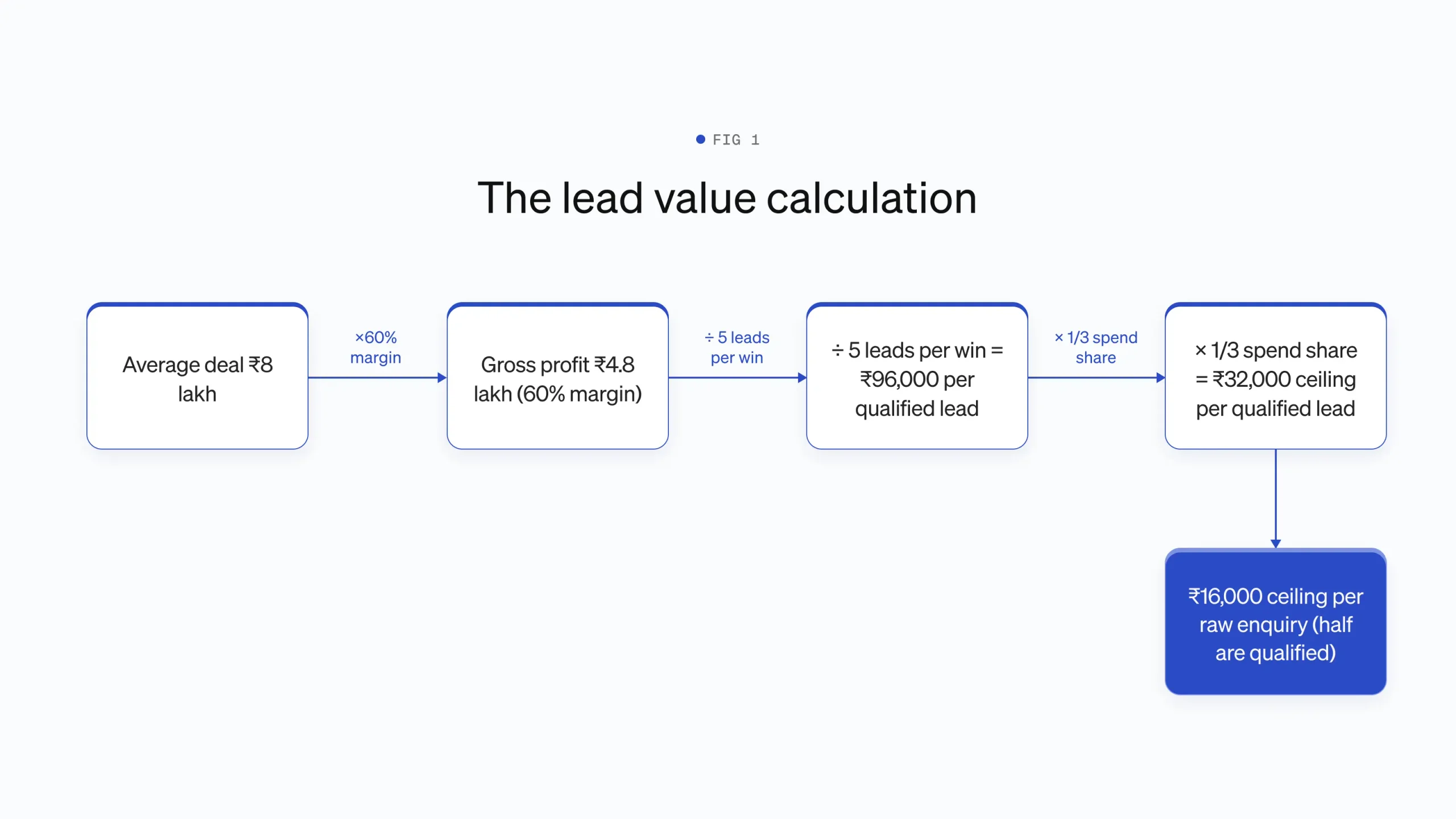
Start with the profit in one won deal, not the revenue. Take a small consultancy whose average project brings in ₹8 lakh in fees. Delivering it costs ₹3.2 lakh in salaries and subcontractors, so the gross profit in one deal is ₹4.8 lakh. Budget from that ₹4.8 lakh. You cannot spend revenue, because most of it is already committed to doing the work.
Divide by your close rate. If the consultancy wins one deal from every five qualified leads, each qualified lead carries an expected gross profit of ₹96,000, which is ₹4.8 lakh divided by five. That is the most a lead could ever be worth, and only if acquiring it cost nothing and you wanted no profit from the project.
Then decide what share of that profit you will spend on winning the work. A workable rule for a services company is between a fifth and a third of expected gross profit. At a third, the consultancy can pay up to ₹32,000 for a qualified lead. If experience shows that only half of raw enquiries turn out to be qualified, it can pay up to ₹16,000 for a raw enquiry. Those two ceilings, ₹32,000 and ₹16,000, are the numbers every channel gets judged against. A channel producing enquiries at ₹20,000 each looks cheap until you know the ceiling is ₹16,000.
One adjustment is allowed. If a typical client comes back for a second and third project, the profit from those belongs in the calculation too, and the ceiling rises. Make that adjustment only with your own numbers from past clients, not with a hoped-for figure. If you have no repeat-work history yet, budget on the first project alone.
Lead scoring is a way of ranking enquiries so attention goes to the strongest first. Each lead collects points for things you know about it, and the total decides who gets a call today and who gets an email this week. That is all it is. The tooling can be a CRM feature or a spreadsheet column, and for a small company the spreadsheet is usually better because you can see the workings.
Score fit and intent as two separate numbers, not one. Fit asks whether this is the kind of company you serve: the right industry, the right size, a budget above your minimum, a country you can work in. Intent asks whether this person is behaving like a buyer: they asked for a call rather than a document, they visited the pricing page, they replied within an hour. A single blended score hides which of the two is missing, and the two gaps call for opposite responses. High fit with low intent is the right company at the wrong time, and belongs on a keep-in-touch list. High intent with low fit is an eager enquiry you should decline early and politely, before it costs you a discovery call and a proposal.
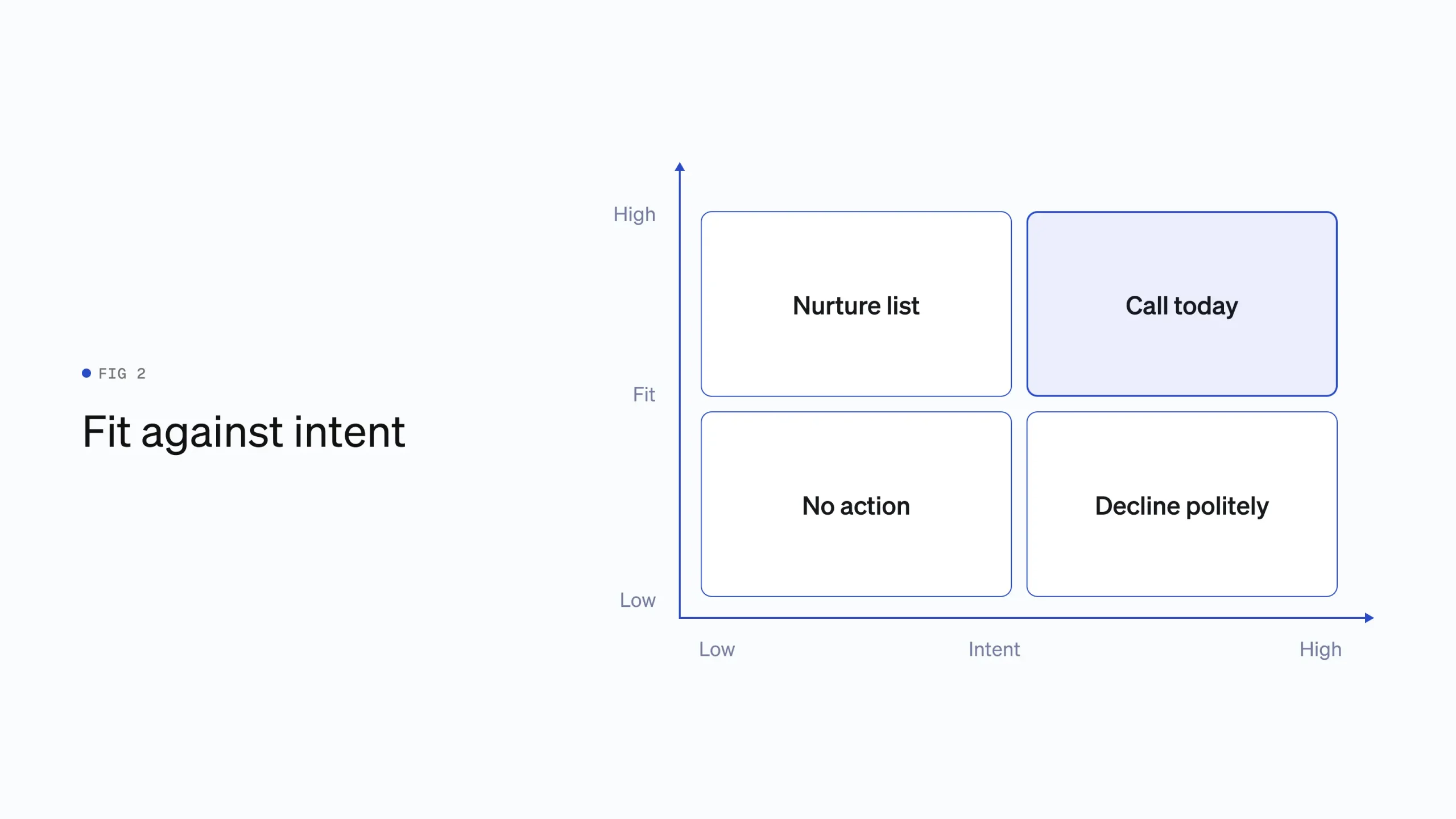
A model a small company can run looks like the table below. Fit points come from the form answers and the company’s website. Intent points come from what the person did. A lead needs a threshold in each column, not a combined total, before it earns same-day attention. A workable pair of thresholds for this table is 30 fit points and 30 intent points.
| Signal | Type | Points |
|---|---|---|
| Industry matches one you have past work in | Fit | +20 |
| Company has 10 to 100 employees | Fit | +15 |
| Named a budget above your minimum | Fit | +25 |
| Based in a country you serve | Fit | +10 |
| Asked for a call rather than a download | Intent | +30 |
| Visited the pricing page before submitting | Intent | +15 |
| Replied to your first email within a day | Intent | +20 |
| Returned to the site within a week | Intent | +10 |
| Message mentions coursework or job seeking | Negative | −40 |
| Email domain belongs to a competitor | Negative | −50 |
| Based in a country you do not serve | Negative | −30 |
Negative scoring removes the leads that look active but will never buy. Students researching an assignment, competitors checking your pricing, and enquiries from countries you cannot serve all behave like interested buyers. They click, they download, they return. Without negative points they float to the top of the list and absorb the attention your real prospects should get. Subtracting points is how the model says no on your behalf. Be careful with one common negative signal: a free Gmail or Outlook address is weak evidence, because plenty of founders of real companies use one.
Below roughly 50 leads a month, do not build scoring at all. Scoring exists to triage a volume no one can read. If you receive two enquiries a week, read them. A person reading two enquiries makes better calls than any points model, and the hours spent building and maintaining the model are hours not spent replying. A one-person consultancy with five leads a month needs no scoring. A 40-person SaaS company with 300 sign-ups a month cannot operate without it. Between those two sizes, the honest test is whether leads are currently waiting more than a day because no one knows which to answer first. If they are not waiting, you do not have the problem scoring solves.
What happens in the first hour after a form submission
Response speed is the cheapest thing to fix in the whole lead generation process, and at most small companies it is the most broken. A form submission that waits two days for a reply was answered by a competitor on the first afternoon.
The evidence for fast response is old but consistent in direction. Research published in Harvard Business Review in 2011 by James Oldroyd, Kristina McElheran and David Elkington, under the title The Short Life of Online Sales Leads, audited responses to 1.25 million web-generated leads across 29 B2B and 13 B2C companies. Firms that attempted contact within an hour were nearly seven times as likely to have a meaningful conversation with a decision maker as firms that waited even an hour longer. Be aware of what this does not establish. It measured qualification conversations, not revenue won. It is American data from before 2011, and it shows a pattern, not a guarantee for your company. The mechanism behind the pattern is plain enough, though: an hour after submitting, the person is still at their desk, still thinking about the problem, and has probably not yet filled in a second company’s form.
Send an automatic acknowledgement within a minute of submission. It is not a substitute for a human reply. Its job is to set an expectation the human reply then beats. A good acknowledgement contains four things:
- Confirmation that the message arrived, echoing back what they submitted so they can check it.
- What happens next, with a deadline and a name: “Anna will reply by email or phone before 5pm today.”
- A reply-to address a person reads. Never a no-reply address, which tells the sender their answer is unwanted.
- At most one link to something useful while they wait, such as a relevant piece of past work. On what a case study needs before a founder will read it, there is a separate article.
Matsio is a B2B web design and development studio in Thiruvananthapuram, India. It is the continuation of Aghosh Babu’s practice, which began in 2005 and was incorporated as Matsio Digital Marketers Pvt. Ltd. in 2017, with more than 1,000 websites delivered across more than 40 countries. Form handling is where the studio finds the largest gap between what a company believes happens and what does happen. Tracing a test enquiry through the system, from submission to the person who answers it, is a short exercise that regularly finds a step nobody owns. 85% of the studio’s clients return for further work, measured across every engagement since 2005.
Do not write the acknowledgement to sound like a human typed it. People recognise the trick within one sentence, and it spends trust you will want later.
Every lead needs a named owner and a fallback, decided in advance. In a small company the routing rule can be one line: all form submissions go to Anna, and a copy lands in a shared inbox or team channel that at least one other person watches. If the lead is unclaimed after 15 minutes during working hours, the second person takes it. Before anyone goes on holiday, the form notification is reassigned, not forwarded, because forwarding chains are where leads go missing. In a larger company the same logic runs on rules: by territory, by product line, or round robin across the sales team. This routing is work a machine should do, and how automation fits into a lead handling process is covered in its own article.
The first human message should quote what they wrote and ask one question. Its purpose is to prove a person read the enquiry and to start an exchange, not to sell or to send a brochure. An example, replying to an enquiry about inventory reporting:
“Thanks for your message about the stock reporting problem between your warehouse and your accounts. Two questions before I suggest anything: which system holds the stock data today, and is there a date this needs to work by? If a call is easier, I’m free Thursday morning.”
That is the whole message. It shows the enquiry was read, asks questions whose answers qualify the lead, and offers a call without demanding one. The craft of this message is its own subject, covered in how to write an email that starts a project conversation.
Call first when they gave a phone number and the deal is large. Email first when they asked a written question. A person who typed their mobile number into an optional field has said calling is acceptable. A person who asked a detailed technical question wants a considered answer they can forward to a colleague, and a call interrupts them mid-thought. Deal size matters because a ₹32 lakh engagement justifies the small social risk of a call and a ₹32,000 one does not. Time of day matters too. A call at 8pm from an unknown number is not a sales technique, it is a nuisance.
Run the same sequence every time, with these timings during working hours:
- Minute 0 to 1: automatic acknowledgement with the named owner and the reply deadline.
- Within 1 hour: first human contact. Phone if a number was given and the enquiry warrants it, otherwise the one-question email above.
- Same day, around hour 4: if the call went unanswered, a short email saying you called and asking the same one question.
- Day 2: second attempt on the other channel from the first.
- Day 5: third attempt, this time adding something useful, such as an answer to a question companies like theirs usually ask.
- Day 10: a closing note. “I’ll stop emailing now. If the project comes back on the agenda, this thread is the fastest way to reach me.” Then move them to the nurture list.
For submissions that arrive outside working hours, the acknowledgement changes its promise to “before 10am on the next working day” and the sequence starts then. Do not have salespeople replying at midnight to look keen. It sets an expectation of availability you will not sustain.
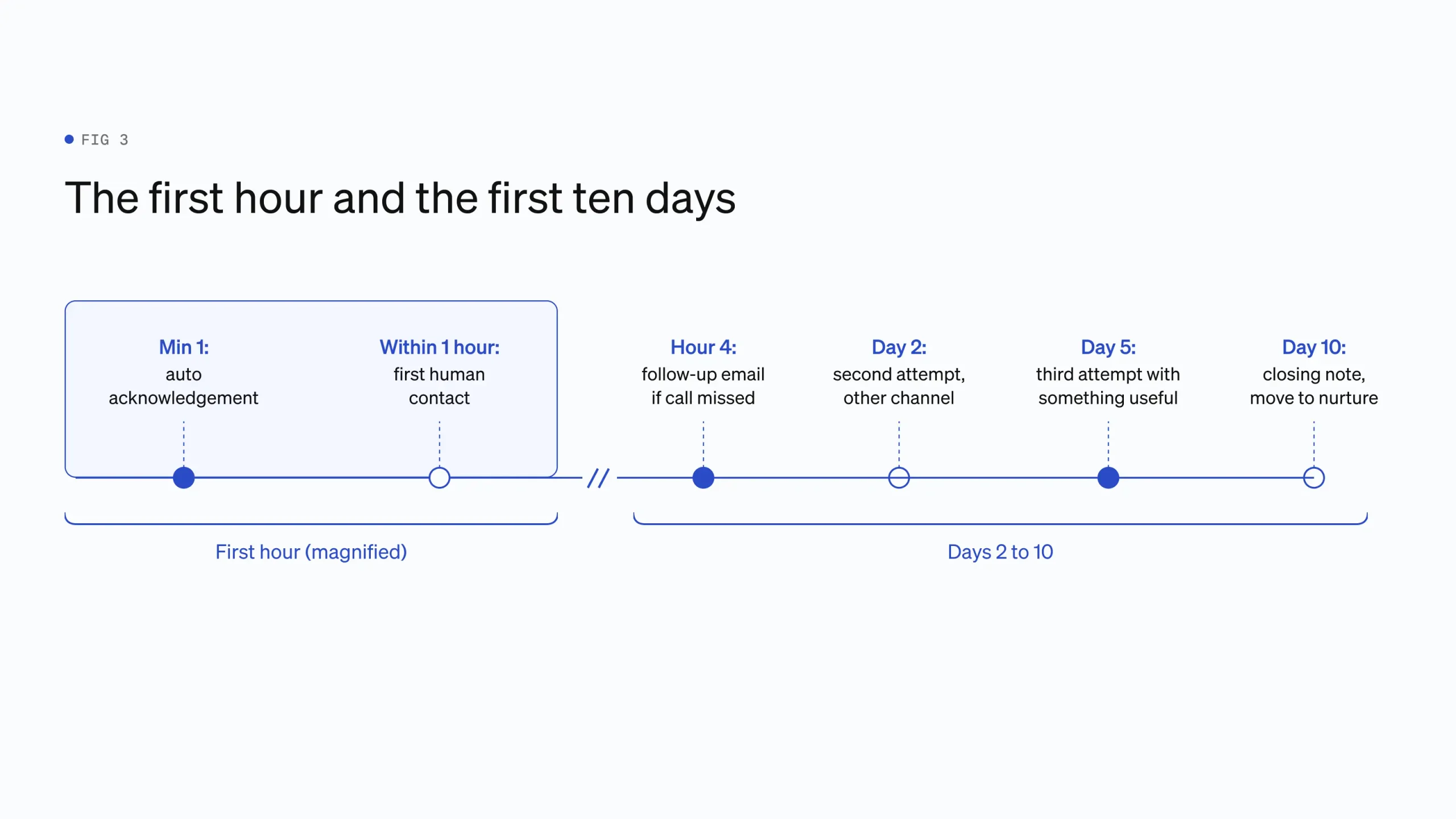
Stop after four or five attempts across ten working days. Beyond that, further attempts cost goodwill faster than they recover leads. The closing note matters more than it looks. It is the message silence-prone buyers most often answer, because it removes the pressure to have a fully formed reply. A lead that never responds is not deleted. It moves to the nurture list described in the next section, where the cost of keeping in touch is near zero.
When a lead passes from marketing to sales, a record travels with it or the first hour is wasted. The record holds: the source and campaign the lead came from, the form answers word for word, the pages they visited, anything they downloaded, every email already sent to them, and the fit and intent scores if you keep them. Without this, the salesperson opens with questions the person already answered on the form, which reads as not listening. In a two-person company the record is a spreadsheet row. In a larger one it is the CRM contact, and the handover rule is that sales accepts or rejects the lead within a stated time, so nothing sits unowned. If the conversation qualifies and moves forward, the next document that has to earn its reading is the proposal, and how to write a proposal that gets read past page one covers that stage.
Email nurture for a long sales cycle
Most B2B enquirers are not ready to buy when they first appear, and in a long sales cycle the gap between first contact and signed work runs to months. Email is the only affordable way to stay present across that gap. If your typical cycle runs to two quarters, the emails and the site have to work together, which is the subject of how to plan a website around a six month sales cycle.
Most nurture sequences fail because every message sells. The recipient opens two emails, finds a pitch in both, and concludes that nothing in this sender’s emails is for them. From then on the messages are deleted unread, and eventually reported as spam, which damages delivery to everyone else on the list. The test for every message before it goes out: would a person who is six months from buying, and knows it, still be glad this arrived? If the answer is no, the message is a pitch wearing a nurture label.
A useful sequence gives four times before it asks once. Here is a worked example of five messages over eight weeks, for someone who downloaded a pricing guide and then went cold:
- Message 1, day 0: deliver the guide, with two sentences on which section answers the question people download it for. No pitch, no “book a call” button.
- Message 2, day 7: answer the question buyers at this stage ask most often, in the body of the email itself, not behind a link. For the pricing guide, that is usually “what makes a project land at the top or bottom of these ranges”.
- Message 3, day 21: one client story with real numbers and a named problem. The evidence on why a specific account of someone like the reader carries weight is set out in How social proof works, according to Cialdini’s research.
- Message 4, day 35: address the money objection head on. What the work costs to skip, how companies budget for it, what the finance director will ask. The article on what CFOs look for when they visit a vendor’s website makes good raw material here, because the reader is often assembling a case for that exact person.
- Message 5, day 56: the ask, made plainly and made easy to decline. “If this is on your list for this year, a 20-minute call would tell you whether the budget range in the guide applies to you. If not, no reply needed, and the guide is yours either way.”
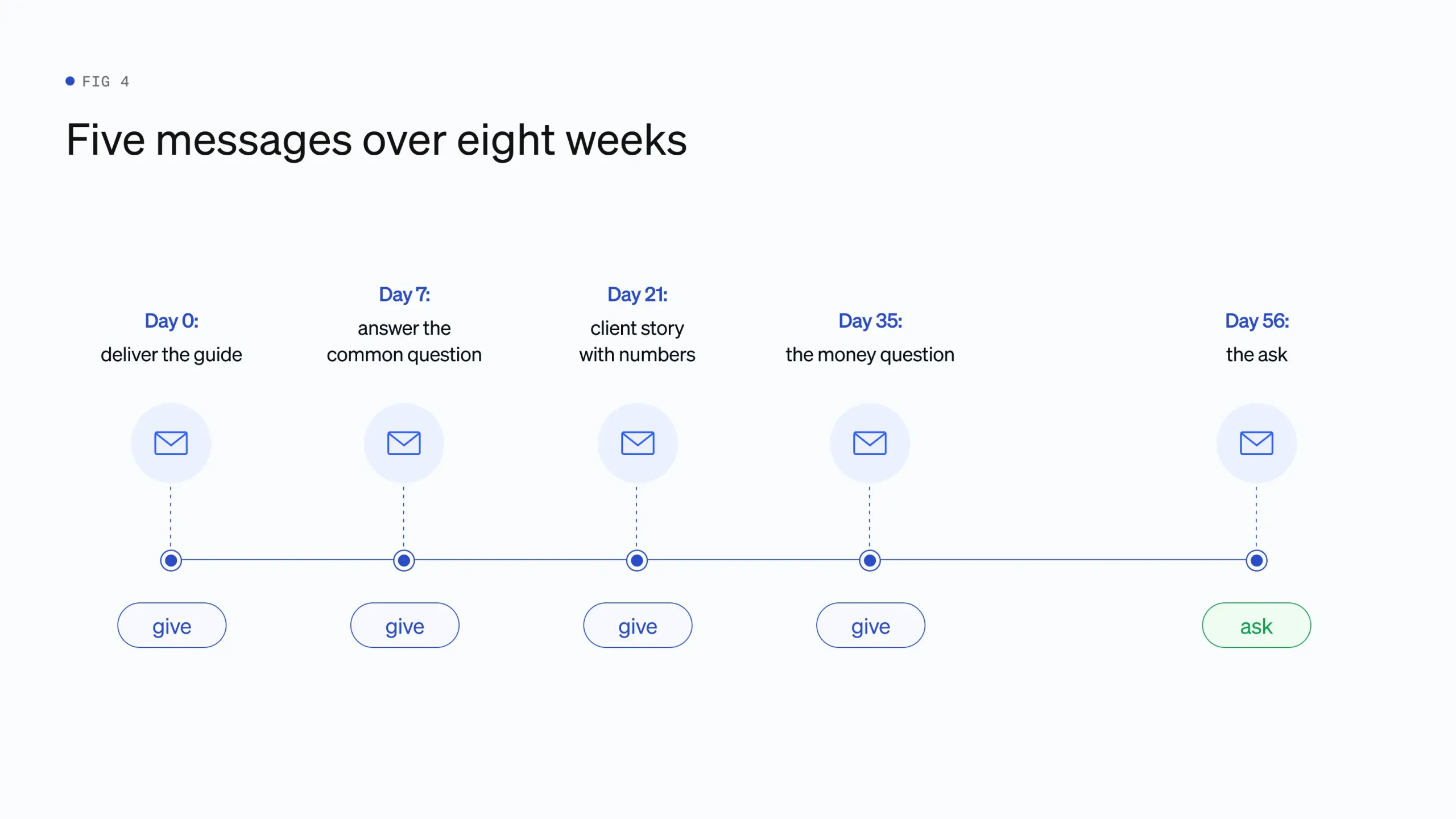
Once a week is the ceiling for someone who has shown mild interest, and the gaps should widen over time. The example above starts at a week and stretches to three. Frequency is the main driver of unsubscribes and spam complaints, and complaint rates feed directly into whether mailbox providers deliver your future email at all. When in doubt, send less often and make each message carry more.
Segment by what the person did, not by who they are. Job titles are a weak guide to interest. Behaviour is a strong one. The person who read three client stories should get the sequence that leads with results. The person who downloaded the pricing guide should get the sequence about cost and scope. For behavioural segments to work, the material has to exist for each stage, and testimonial material in particular needs the concrete detail described in how testimonials work when they carry specifics. One more reason behaviour beats title: the email lands in one inbox, but in B2B it gets forwarded, and the message has to survive readers you never wrote it for. That is the same constraint a homepage faces, covered in how to write a homepage for a buying committee.
A nurture sequence and a newsletter are different machines, and at first you should run one, not both. A sequence is a fixed set of messages, written once, triggered by an action, and every subscriber starts at message one regardless of when they join. A newsletter is written fresh on a calendar and everyone gets the same issue at the same time. Start with the sequence. It is a bounded writing job of perhaps five messages, it improves every new lead from the day it exists, and it never misses an issue. A newsletter is an open-ended commitment, and one that skips three months tells subscribers more about your capacity than any of its issues did. Add the newsletter later, when the sequence is running and you have material left over.
Remove people who stop responding, on a schedule. After six months with no click and no reply, send one re-engagement message: a short note asking whether they want to keep receiving these, with a one-click way to stay. No response within two weeks means removal. This feels wasteful and is not. A list full of dead addresses raises your cost with the email platform, lowers your engagement rates, and tells mailbox providers your mail is unwanted, which pushes the rest of the list toward the spam folder. List size is a cost. Replies are the asset.
Measure replies, clicks and unsubscribes per message. Ignore open rates. Since Apple introduced Mail Privacy Protection in 2021, its mail apps preload messages whether or not a human looked at them, so open rates overstate attention by an unknowable amount that differs per list. Per-message numbers are what you act on. A click rate that drops at message 4 locates the weak message. An unsubscribe spike at message 2 says the promise made at sign-up is not being kept. Replies are the measure that matters most and the one dashboards show least, so count them by hand if you have to.
Three DNS records decide whether your email arrives at all. SPF is a public list of the servers allowed to send email for your domain. DKIM is a signature added to each message proving it came from you and was not altered on the way. DMARC is the policy that tells receiving servers what to do when a message fails those checks, and where to send reports about it. Your email platform’s settings page lists the exact records to add at your domain registrar, and the job takes under an hour. It is not optional housekeeping. Since February 2024, Google and Yahoo require SPF, DKIM and DMARC from bulk senders, alongside one-click unsubscribe and a spam complaint rate below 0.3%, as set out in Google’s email sender guidelines.
Never send cold email from the domain your client work runs on. Nurture email goes to people who asked to hear from you. Cold email goes to people who did not, and some of them will press the spam button. Those complaints attach to your domain’s sending reputation, which is shared by every message the domain sends. Once the reputation drops, your invoices, project updates and proposals start landing in clients’ spam folders, and recovering a damaged domain takes months. The standard workaround is a separate lookalike domain for outreach, and it has its own trap: a newly registered domain has no sending history, so providers filter it hard, and it needs months of low-volume, high-engagement sending before it delivers reliably. If you do cold outreach at all, do it from a separate domain, build the volume over months not days, and accept that the nurture list you built from real enquiries will outperform it on every measure that reaches revenue.
Related reading. How to run paid search and paid social for a B2B business covers where the enquiries being valued here come from, and How lead generation works for SaaS and multi-journey businesses covers how scoring and follow-up change when a product qualifies its own leads through usage.
The short version
A lead’s price ceiling comes from three numbers you already hold: the gross profit in an average won deal, the number of qualified leads it takes to win one, and the share of that profit you will spend on winning the work. For the consultancy used as the example, the ceiling came out at ₹32,000 for a qualified lead and ₹16,000 for a raw enquiry. That ceiling is the number every channel answers to. Scoring then ranks enquiries once volume outgrows a person’s ability to read them, with fit and intent kept as separate numbers so the right response to each gap stays visible.
After submission, speed carries more weight than polish. The working pattern is an automatic acknowledgement within a minute, a human reply within the hour that quotes the enquiry and asks one question, and four or five attempts over ten working days before a closing note, which is the message silent buyers answer most often because it asks for nothing. Anyone who never answers moves to the nurture list, where the discipline is to give four times before asking once, to widen the gaps between messages over time, and to judge every message by whether a reader six months from buying would still want it.
This stage sits in the middle of a longer process. The guide to the end-to-end lead generation process covers what comes before and after it: choosing channels that can produce enquiries under the ceiling worked out here, building the pages and forms those channels point at, and measuring the pipeline from first visit to signed work. The affordability arithmetic in this article connects those stages, so read the channel sections with your two ceilings to hand.
A small thing and a big thing
One small thing to fix on your website today, and one big thing to learn that gets you more leads.




 Your information is
safe with us. No spam.
Your information is
safe with us. No spam.