



A company with a website, a contact form and no enquiries has a lead generation problem, and the form is rarely the cause of it. The page it sits on may be reaching nobody. The offer it makes may be one nobody wants. The enquiries it does collect may be sitting in an inbox that gets read on Fridays. Each of those is a different problem with a different fix, and the cost of guessing wrong is a year of effort spent on the part that was already working.
This guide sets out the whole process, in the order you would build it. It starts with the smallest system that produces enquiries, which is one page, one form, one campaign and one follow-up email, and which is enough for a large number of businesses. It ends with the arrangement a software company runs when it has four buying routes operating at once and a committee of eight people on the other side of each deal. Most readers need something between the two, and the point of laying out the full range is to let you find where you are rather than build for a stage you have not reached.
It is written for the person doing the work. Where a step involves a specific tool, the steps name the actual settings. Where a number would help, the number comes with its basis, and where no trustworthy number exists, that is stated rather than filled with a benchmark borrowed from someone else’s industry. Published cost-per-lead figures vary so widely between sectors and countries that quoting one would mislead more than it informs.
Some of what follows has changed in the last two years and some of it has not. Forms, offers and follow-up work much as they did in 2015. What has moved is where buyers do their research before they arrive, which now includes assistants that answer questions without sending anyone to a website, and what channels cost, which has risen across paid search and paid social. Both are covered, and both are separated from speculation about what may happen next.
A lead generation system has four parts: an offer, a place to accept it, traffic arriving there, and something that happens afterwards. Remove any one and the other three produce nothing. Most companies that describe their marketing as not working have three of the four.
In this article
What lead generation means, and the words people use for it
A lead is a person who has given you a way to contact them and a reason to believe they might buy. Both halves matter. An email address scraped from a directory is contact information without interest. A visitor who read four pages of your site and left is interest without contact information. Lead generation is the work of producing people who are both reachable and plausibly in the market.
The vocabulary around leads is larger than it needs to be. You will meet nine terms that overlap, and different companies use them to mean different things. Here is a working set of definitions.
| Term | What it usually means |
|---|---|
| Contact | Anyone whose details you hold, for any reason. A newsletter subscriber, a past client, a person who downloaded a guide three years ago. |
| Prospect | A person or company that fits your target market, whether or not they know you exist. A list of prospects is a list of people you could sell to, not people who have shown interest. |
| Enquiry | Someone who contacted you first, by form, phone or email, asking about your work. The most direct kind of lead. |
| Lead | A contact who has shown some sign of buying interest. The broadest term, and the one companies argue about most. |
| MQL | Marketing qualified lead. A lead that marketing judges worth passing to sales, based on criteria such as job title, company size or which pages they viewed. |
| SAL | Sales accepted lead. An MQL that a salesperson has looked at and agreed to work, rather than rejecting as unsuitable. |
| SQL | Sales qualified lead. A lead a salesperson has spoken to and confirmed has a need, a budget and some intention to buy. |
| Opportunity | A lead that has become a live deal, usually with a value and an expected close date attached in a CRM. |
| Conversion | Any moment a visitor does the thing a page asked of them. Filling a form is a conversion. So is booking a call. The word describes an action, not a person. |
None of these labels is an industry standard. They are internal agreements, and they only work when everyone in the company has agreed what each one means. A five-person consultancy needs two of them at most, enquiry and opportunity. A 40-person SaaS company with separate marketing and sales teams needs the fuller set, because the handover between teams is where leads go missing.
The disagreement about what counts as a lead is the most common reason a system appears to work while producing nothing. Marketing reports 80 leads a month and hits its target. Sales calls those 80 people, finds most are students, competitors and the idly curious, and stops calling. Marketing keeps reporting the number. Revenue does not move. Nobody has lied, the two teams are counting different things with the same word. The fix is not a tool. It is a written definition, agreed by both sides, of what a lead must have before it counts: for example, a work email address, a company in your target industries, and an answer to one qualifying question on the form.
Demand generation and lead capture are different jobs. Demand generation is the work of making people want the thing and know you provide it, through articles, talks, a podcast, useful tools, being recommended. Lead capture is the work of collecting details from people whose interest already exists. Most buying activity happens before any form is filled. Research from Gartner on B2B buying describes buyers spending most of their purchase process on independent research rather than talking to suppliers. That behaviour is described in more detail in how B2B buyers use your website before they ever talk to sales. A company that only does capture is arguing over a small pool of people already in motion. A company that only does demand generation creates interest its competitors collect. You need some of each, and this guide covers both.
Inbound means the buyer moves first. They search for the problem, find your article or your service page, read it, and decide to get in touch. Your work is to be findable and convincing at the moment they look. Inbound leads arrive warmer, because the buyer has chosen to raise their hand, but you cannot control when they arrive or who they are. It suits companies whose buyers search for the problem by name, and it rewards patience, because the assets that bring inbound leads take months to start working. The shift towards buyers researching alone has changed what websites need to do, which is the subject of how self-serve evaluation changed B2B websites.
Outbound means you move first. You choose the companies you want, find the right person, and contact them by email, phone or LinkedIn before they have shown any interest. Your work is targeting and message quality. Outbound leads arrive colder, and most people you contact will not reply, but you control the volume, the timing and exactly who you approach. It suits companies with a narrow, nameable target market, where a list of 300 right-fit companies can be written down. Neither approach is better in general. The right mix depends on whether your buyers search for what you sell, and on whether you can name them before they appear.
The four things every lead generation system needs
Every lead generation system, from a one-page site with a form to a full marketing department, is made of the same four parts. The rest of this guide is organised around them.
- An offer. Something a person will exchange their contact details for. A quote, an audit, a guide, a demo, a call.
- A place where the exchange happens. Usually a page with a form, sometimes a phone number, a booking link or a chat window.
- Traffic arriving at that place. People reaching the page, from search, from ads, from referrals, from outbound messages, from anywhere.
- Something that happens after. A reply, a call, a sequence of emails. The follow-up that turns a captured detail into a conversation.
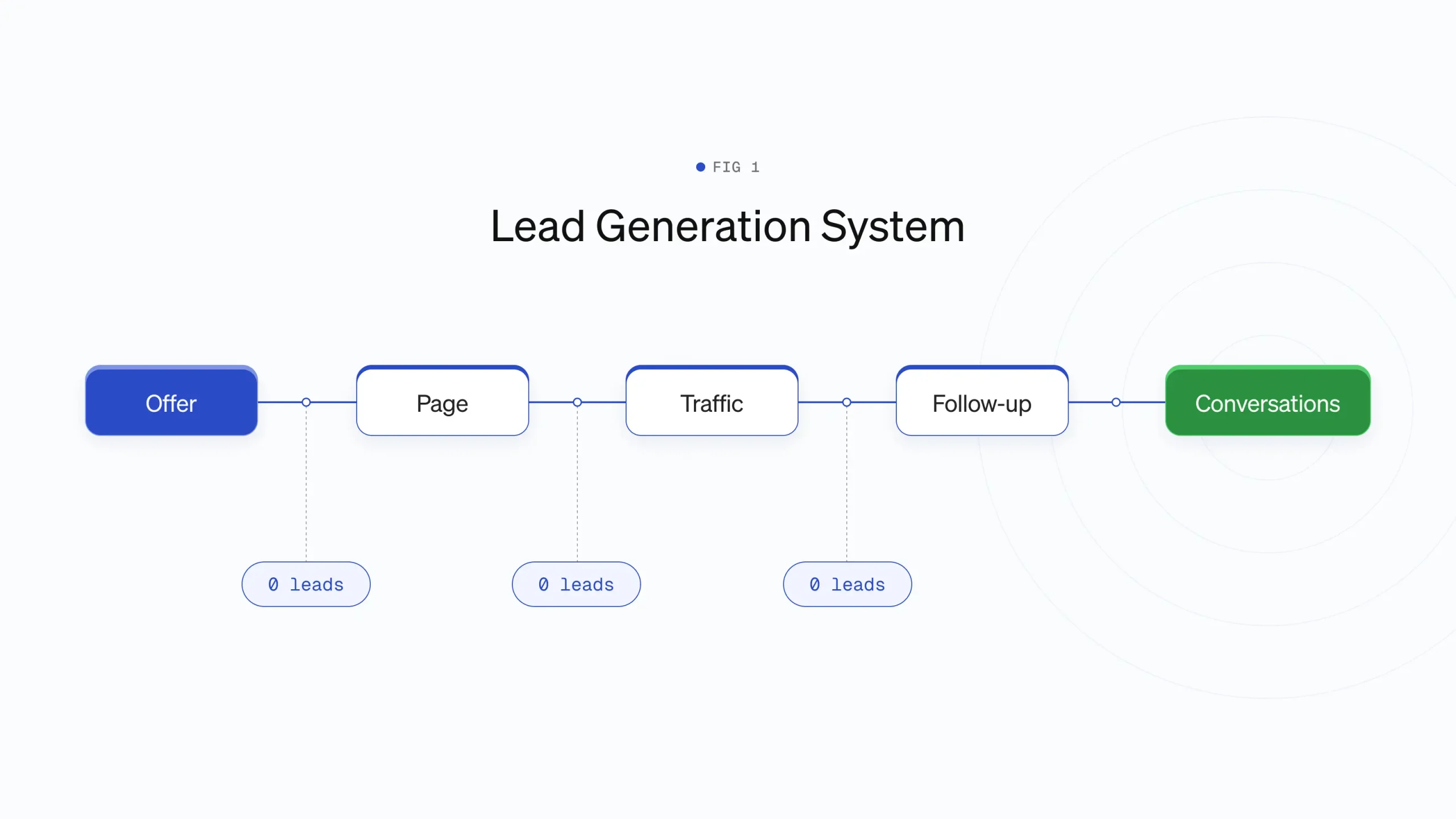
A system missing any one of the four produces nothing. Not less, nothing. The parts multiply rather than add, and a zero anywhere in the chain makes the total zero. This is why most advice on lead generation frustrates the people who follow it. The advice improves one part, the reader’s missing part is a different one, and the result does not change. Most small companies already have three of the four. The useful question is never “how do I get more leads” but “which of the four is my zero”.
Good offer, good page, no traffic. An engineering consultancy writes a detailed guide to specifying a structural survey, builds a clean page with a form, and publishes it. The page is well made. It receives nine visits in its first month, most of them from the consultancy’s own staff. Nothing about the offer or the page is wrong. Nobody arrives. The fix is a traffic source, not a better page, and a month of rewriting headlines will not change the outcome.
Good traffic, no offer. A machine parts manufacturer has a site receiving 2,000 visits a month from search, built up over years of product pages ranking well. The only action available on any page is a generic contact form in the footer. Visitors who are researching, which is most of them, have nothing to do except leave. The site produces two or three enquiries a month from the small fraction of visitors ready to buy today. Everyone else is lost, including the buyers who would have handed over an email for a tolerance chart or a CAD file library. Preparing for those visitors is covered in how to prepare a website for buyers who never fill a form.
Everything working, nobody follows up. A software company runs ads to a demo request page and receives 15 requests a month. The requests arrive in a shared inbox that the sales lead checks when travel allows. The median first reply goes out four days after the request. By then the requester has seen two competitors. The company concludes that the leads are poor quality and cuts the ad budget. The leads were fine. The system had a zero in the fourth position, and the fix was a same-day reply, not a different audience.
Diagnose before you build. Work through the four in order and find the first one that is missing or weak. If you have no offer beyond “contact us”, start there. If the offer exists but lives on a cluttered page, fix the page. If the page is sound and empty, buy or earn traffic. If leads arrive and go quiet, fix the follow-up. Later parts of this guide take each of the four in turn.
How to choose the offer people will give their details for
An offer is worth someone’s email address when it saves them work they were already going to do. That is the whole test. A buyer researching a purchase has tasks in front of them: understand the options, estimate the cost, compare suppliers, justify the decision internally. An offer that completes one of those tasks for them is worth a form fill. An offer that adds to their reading pile is not.
“Contact us” is an offer, and a weak one. It asks the visitor to start a sales conversation in exchange for nothing specific. The visitor must already want to talk to a salesperson, must compose a message from scratch, and does not know what happens next or how soon. Some fraction of buyers, the ones at the very end of their research, will do it anyway. Everyone earlier in the process has been offered nothing they want yet. A site whose only offer is “contact us” captures only the buyers it was going to get regardless.
Offers sit on a ladder of commitment. At the bottom are offers that cost the visitor little: a checklist, a pricing guide, a calculator, a template. They ask for an email and nothing else, and they attract people early in their research. At the top are offers that cost the visitor time and exposure: a demo, an audit of their current setup, a detailed quote, a consultation. They ask for a conversation, and they attract people close to a decision. The middle holds things like webinars, sample reports and trial accounts. Higher rungs produce fewer, better leads. Lower rungs produce more, earlier ones.
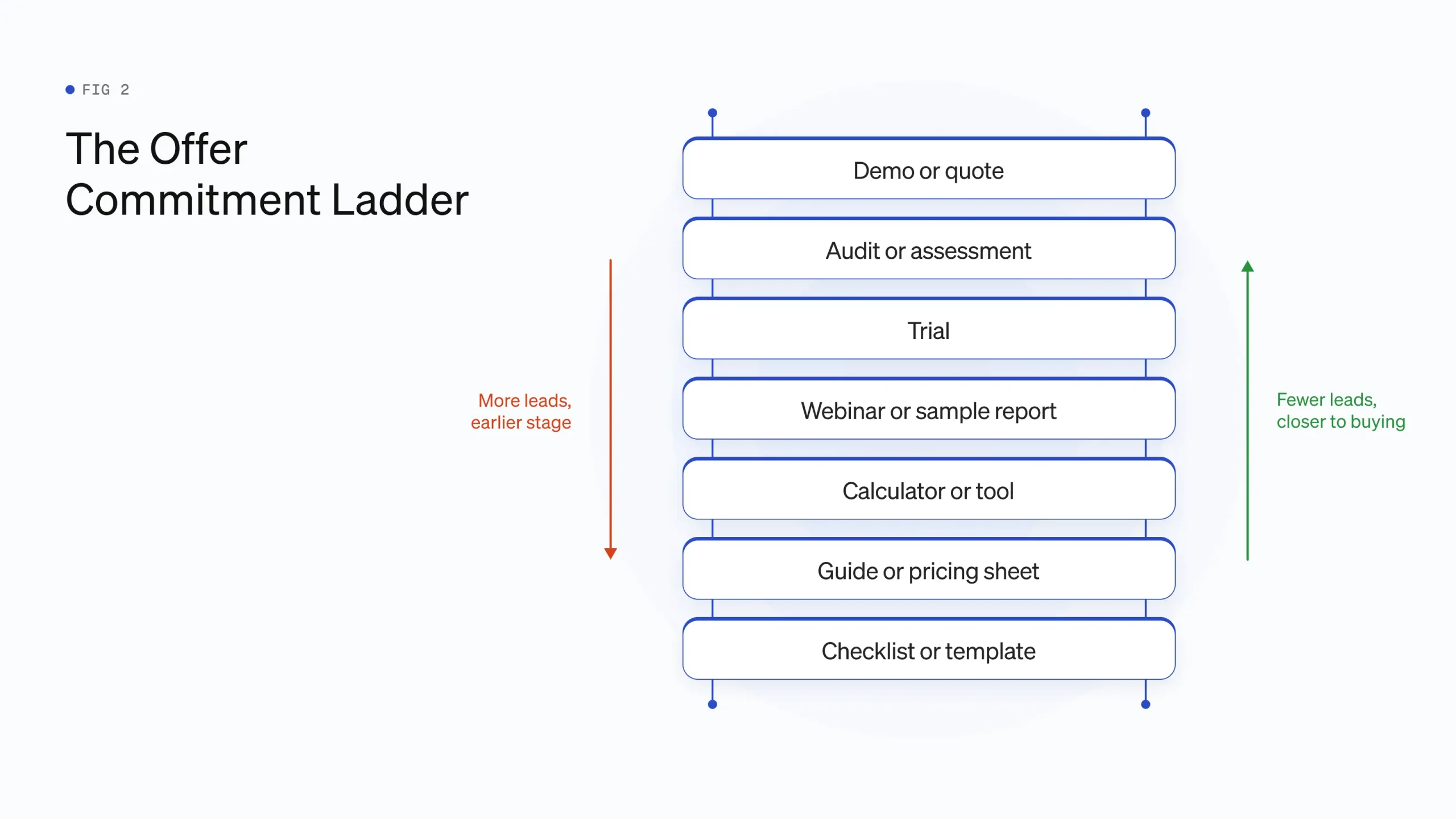
Match the offer to where the buyer is, not to where you want them to be. A visitor who has just recognised a problem will not book a demo, and a visitor with budget approved does not want another beginner’s guide. Most sites need one offer near each end of the ladder: a low-commitment offer for researchers and a high-commitment offer for deciders. Adding many similar options in between tends to reduce action rather than increase it, for the reasons set out in how choice research explains shorter service pages. Two clear offers outperform six vague ones.
An offer aimed at everyone brings leads worth nothing. “The complete guide to marketing” will be downloaded by students, job hunters and competitors, and your follow-up time will be spent finding the two real buyers among them. “What a rebrand costs for a 20 to 100 person professional services firm” will be downloaded by fewer people, nearly all of whom are your market. Specificity in the offer is the cheapest qualification step you have, because the wrong people rule themselves out before they ever reach your inbox. The same discipline applies to what you call your services in the first place, covered in how to name your services so buyers understand them.
Concrete offers, by business type. The pattern in each is the same: take a task the buyer already faces and do part of it for them.
- A management consultancy: a self-assessment scorecard the reader completes in ten minutes, scoring their own operation against the criteria the consultancy uses in paid engagements.
- A consultancy, higher on the ladder: a 30-minute review call with a written one-page summary of findings afterwards, so the caller leaves with an artefact rather than a pitch.
- A manufacturer: downloadable CAD files, datasheets and tolerance tables behind a short form, because a design engineer who pulls your drawings into their model is far along the path to specifying your part.
- A manufacturer, higher on the ladder: a free sample or a machined test piece sent to a business address, which also confirms the enquirer is a real company.
- A SaaS company: an interactive product tour that needs no sales call, with the email asked for at the point the visitor wants to save their progress or see their own data in it.
- A SaaS company, higher on the ladder: a migration assessment, where the vendor looks at the prospect’s current setup and returns a written plan for moving off the incumbent tool.
- A local services firm, such as a commercial electrician: a fixed-price call-out menu or an instant estimate form, because the buyer’s first task is finding out what this costs and most local competitors make them phone to ask.
- A local services firm, higher on the ladder: a free site survey with a written compliance checklist left behind, which the facilities manager can file as evidence of due diligence whether or not they buy.
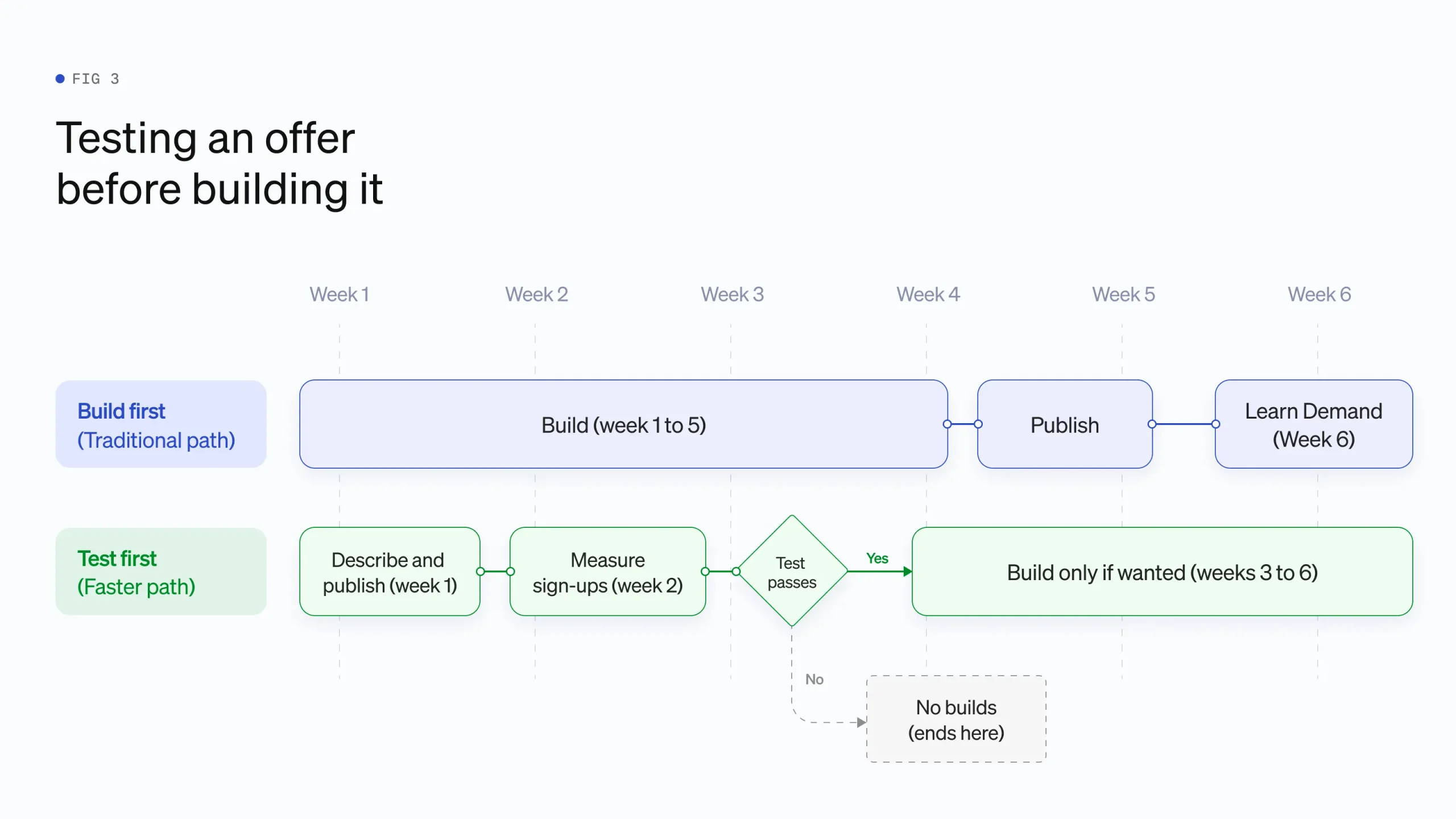
Test the offer before you build it. Most offer ideas fail, and the expensive way to learn that is to spend six weeks producing the guide first. The cheap way is to sell the offer before it exists and count who says yes.
- Write one page describing the offer as though it were finished: what it is, who it is for, what the reader will be able to do afterwards. A single page on your existing site is enough. No downloadable asset exists yet.
- Put a form on it asking for name and work email, with a note that the material is sent within a few days.
- Send 100 to 200 relevant people to the page. Use whatever you have: an email to your existing list, a LinkedIn post, a small paid campaign, direct messages to people who fit the profile.
- Count the sign-ups. If fewer than a handful of the right kind of people leave their details, the offer as described is not wanted, and you have learnt that for the cost of a page and a few hours. If a meaningful share sign up, build the thing and send it to them first, with a short apology for the wait.
- Repeat with a second offer idea and compare. The comparison matters more than either absolute number, because your traffic source and market set a baseline no benchmark can tell you.
One caution on borrowed offers. An offer that works for a competitor worked in their market position, with their traffic and their follow-up. Copying the format is fine, checklists and calculators are formats, not property. Copying the topic without checking your own audience wants it is how companies end up with a library of unused PDFs. Run the test above even when the idea arrived with evidence attached.
The simplest system that works
The smallest complete lead generation system has four parts: one landing page, one form, one paid campaign, and one email that goes out when someone submits. Nothing else. No marketing automation platform, no CRM with forty fields, no retargeting, no content calendar. Each part exists because removing it breaks the system. A campaign with no landing page sends clicks to a homepage that was written for a different job. A page with no form gives an interested visitor nothing to do. A form with no follow-up email leaves the enquirer wondering whether anything happened.
This system is enough for many companies. If your buyers search for what you sell, and your average sale covers the cost of the clicks it takes to win it, this system will produce enquiries on its own. The most common waste in small-company marketing is adding to a system before it works. A second channel, a nurture sequence, a chatbot, a video: each one added to a system that has not yet produced a customer makes the system harder to diagnose, not more likely to succeed. Build the four parts, run them until they either work or fail for a reason you can name, and only then add anything.
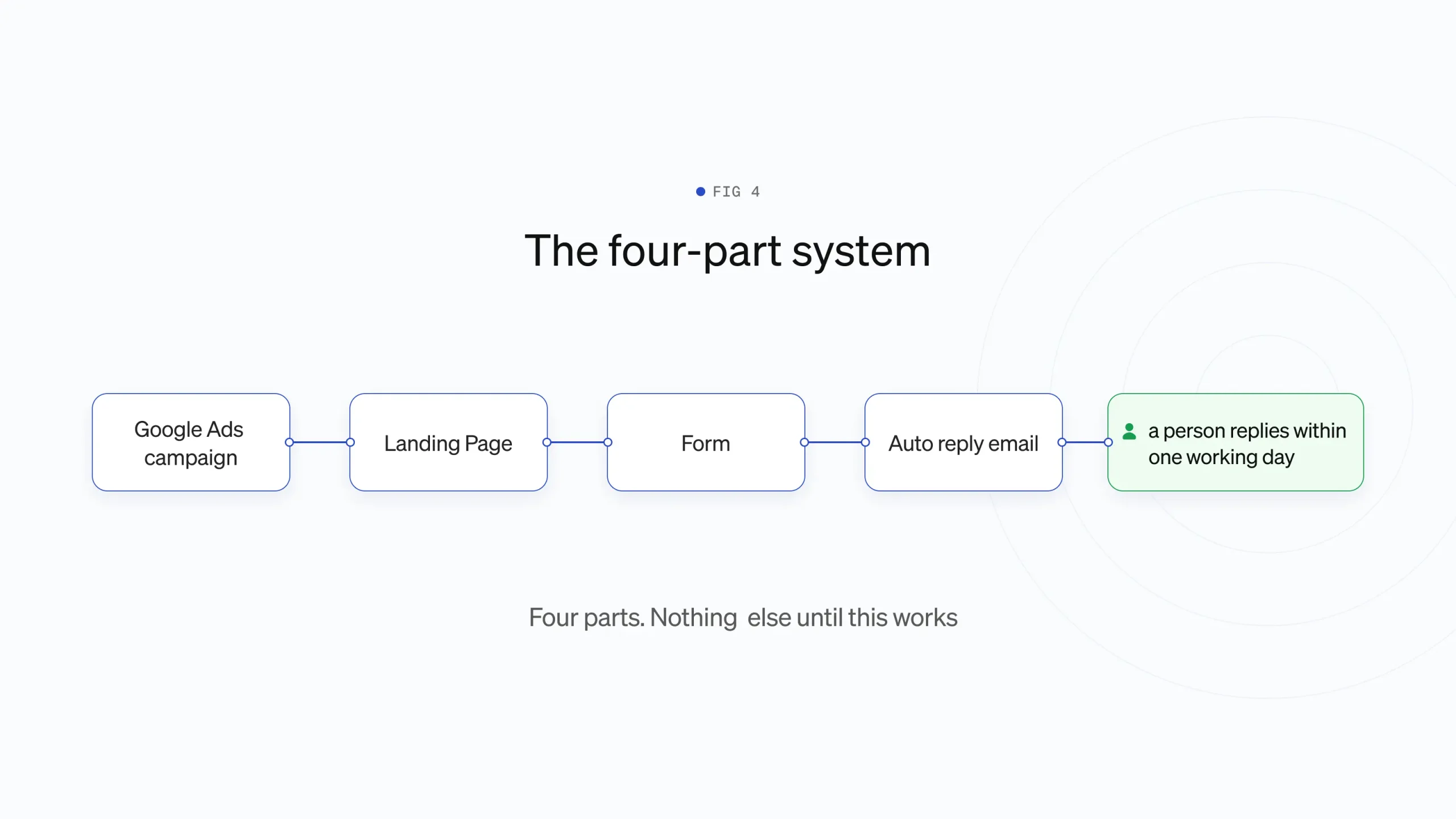
A worked example: a six-person industrial equipment supplier. The company sells and services air compressors to factories within a two-hour drive. Buyers are maintenance managers and plant engineers. When a compressor fails, the manager searches for a supplier who can quote and deliver fast. That search behaviour is what makes this company a good fit for the minimal system: the demand already exists, and the buyer is in a hurry.
Here is the build, in order, with what each step costs. Time estimates assume one person doing this part-time around other work.
- Write the page before you build anything. One headline, one subheadline, three proof points, three objections answered, one call to action. Write it in a plain document. Half a day. Free.
- Build the landing page. Use whatever your site already runs on. If the site is WordPress, a new page with the theme’s existing blocks is fine. If there is no site, a single-page builder works, and most cost between nothing and about ₹2,400 a month. One day if you build it yourself.
- Add the form and a thank-you page. Four fields: name, company, work email, and a message box labelled “What do you need?”. The form redirects to a separate thank-you page at its own URL, because that URL is how you will count conversions. Two hours.
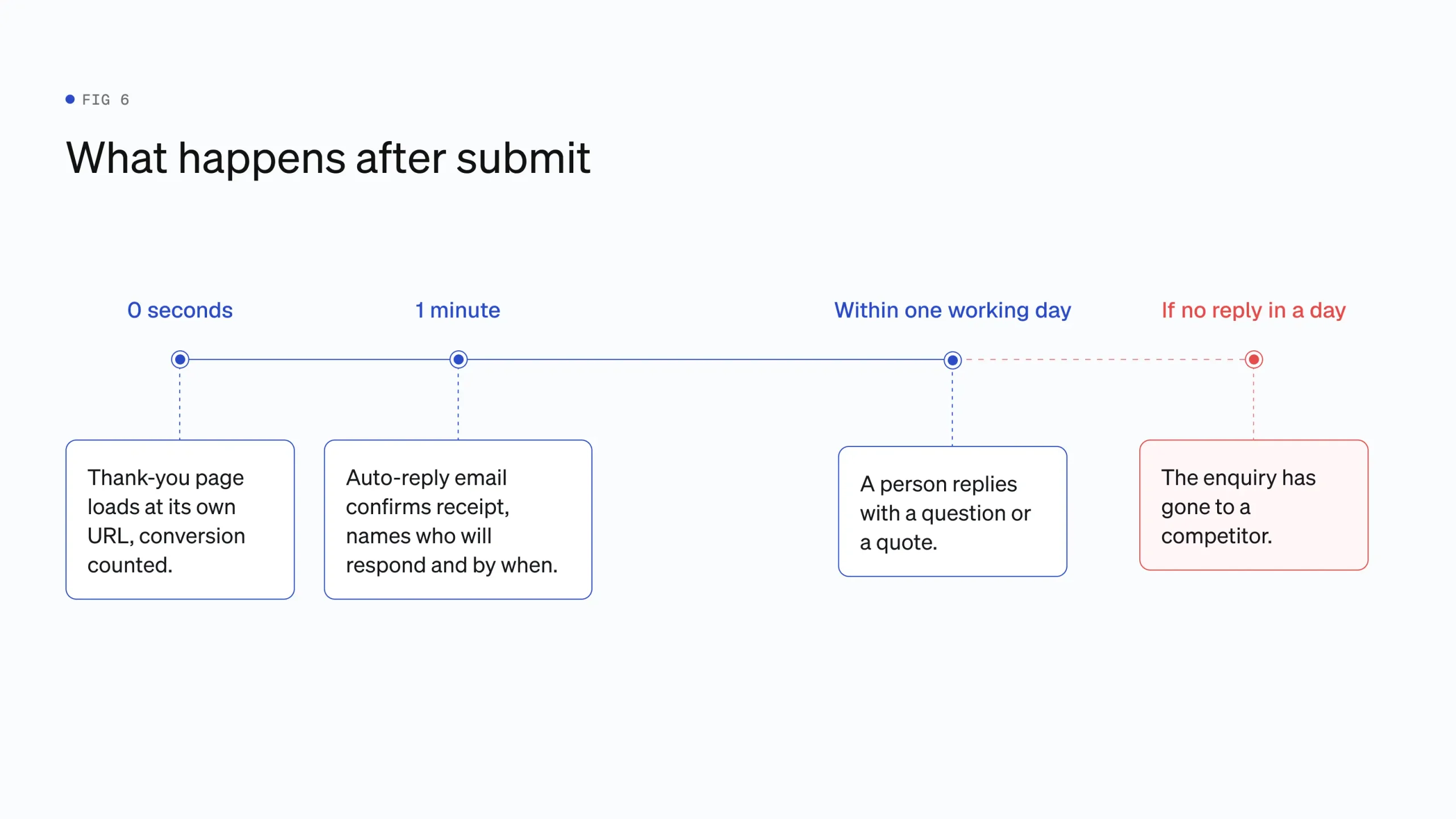
- Write the auto-reply email. It confirms the enquiry arrived, says who will reply and by when, and gives a direct phone number for anything urgent. Three sentences. One hour.
- Set up conversion tracking. In Google Ads, open Goals, then Conversions, then New conversion action, choose Website, and enter the URL of your thank-you page. Now every ad click that ends in a submitted form is counted against the keyword that caused it. One hour.
- Launch one search campaign. One campaign, one ad group, five to ten phrase-match keywords built from what a maintenance manager types: the product, plus “supplier”, “repair”, “hire” or the city name. Set the budget high enough to buy at least 30 clicks a week, because below that you cannot tell a bad campaign from a quiet one. In most industrial categories that means a few tens of thousands of rupees a month. Half a day to set up.
- Reply to every enquiry within one working day. This step is a person, not software, and it is the step most companies fail. The fastest useful reply usually wins the enquiry, and no later improvement to the page or the campaign makes up for slow replies.
Total: about three working days of effort spread over a fortnight, a possible tool subscription, and an ad budget you control month by month. A three-person accounting practice would build the same system with different words on the page and different keywords in the campaign. The structure does not change with the trade.
What this system cannot do. It only reaches people who are searching. If your buyers do not know your category exists, no search campaign will find them, and you need a different approach to create the demand first. It does not nurture a long buying cycle, so an enquirer who is eighteen months from a decision will submit the form and then go cold unless a person stays in touch. It cannot rescue a weak offer. If the page states plainly what you sell and nobody enquires, the finding is about the offer or the price, not the page. And it tells you nothing about the enquiries you did not get, because the only people it measures are the ones who clicked.
How to build the landing page
A landing page has one job: turn a visitor who arrived from one specific ad into one specific enquiry. That is the difference between a landing page and a homepage. A homepage serves every visitor, including existing customers, job applicants and suppliers, so it carries navigation and many routes onward. A landing page serves one visitor with one intent, so it carries one route. You need a dedicated landing page whenever you are paying for the click, because a paid visitor who has to hunt for the thing the ad promised will leave. If your homepage happens to say exactly what the ad says and the form is on it, you can start there, but that stops being true the moment you run a second campaign with a second message.
The headline states what you sell, for whom, and where. “Air compressor supply and repair for factories in the North West” beats any clever alternative, because the visitor arrived from a search and needs to confirm within seconds that this page answers it. The craft of that one line is covered in how to write the line at the top of your homepage, and the same rules apply here with one addition: the headline must echo the keyword the visitor searched. If they searched “compressor repair”, the word “repair” belongs in the headline.
The subheadline carries the one fact the headline could not. Usually that is speed, coverage or scope: “Engineers on site within 24 hours, most parts held in stock.” It answers the first question the headline raises. Do not use it to repeat the headline in different words.
Above the fold, the visitor needs four things: the headline, the subheadline, one piece of proof, and the form or a button that leads to it. Research on first impressions suggests visitors form a judgement of a page far faster than they read it, a finding unpacked in what first impression research says about the first 50 milliseconds, and the practical consequence is that the top of the page must look like what it is: a competent company offering the searched-for thing. The fuller checklist for those opening seconds is in what a B2B website should accomplish in the first five seconds.
The proof section comes next, and it must be specific. Named clients with permission, photographs of your own premises and people rather than stock images, the number of years trading, accreditations the buyer recognises, and one or two short quotes with a full name and company attached. An unattributed quote reads as invented. If you have no named clients yet, state the facts you do have: who founded the company, what they did before, what equipment you hold. Thin true proof beats thick vague proof.
The objection section answers the three questions that stop people enquiring. For the compressor supplier those are price (“what does a call-out cost?”), commitment (“am I signing up to anything by enquiring?”) and coverage (“do you come to my area?”). Answer each in two or three sentences under a plain question-shaped heading. If you cannot publish a price, publish the shape of one: a starting figure, a typical range, or what determines it.
Put the form at the end of the page, and a button to it near the top. The visitor who is ready on arrival clicks the button. The visitor who needs convincing reads down and meets the form exactly when the page has finished its argument. Eye-tracking work, summarised in what eye tracking research says about how people read web pages, shows that people scan down the left edge and along headings rather than reading continuously, so every section heading on the page must carry meaning on its own. A visitor who reads only your headings should still get the whole argument.
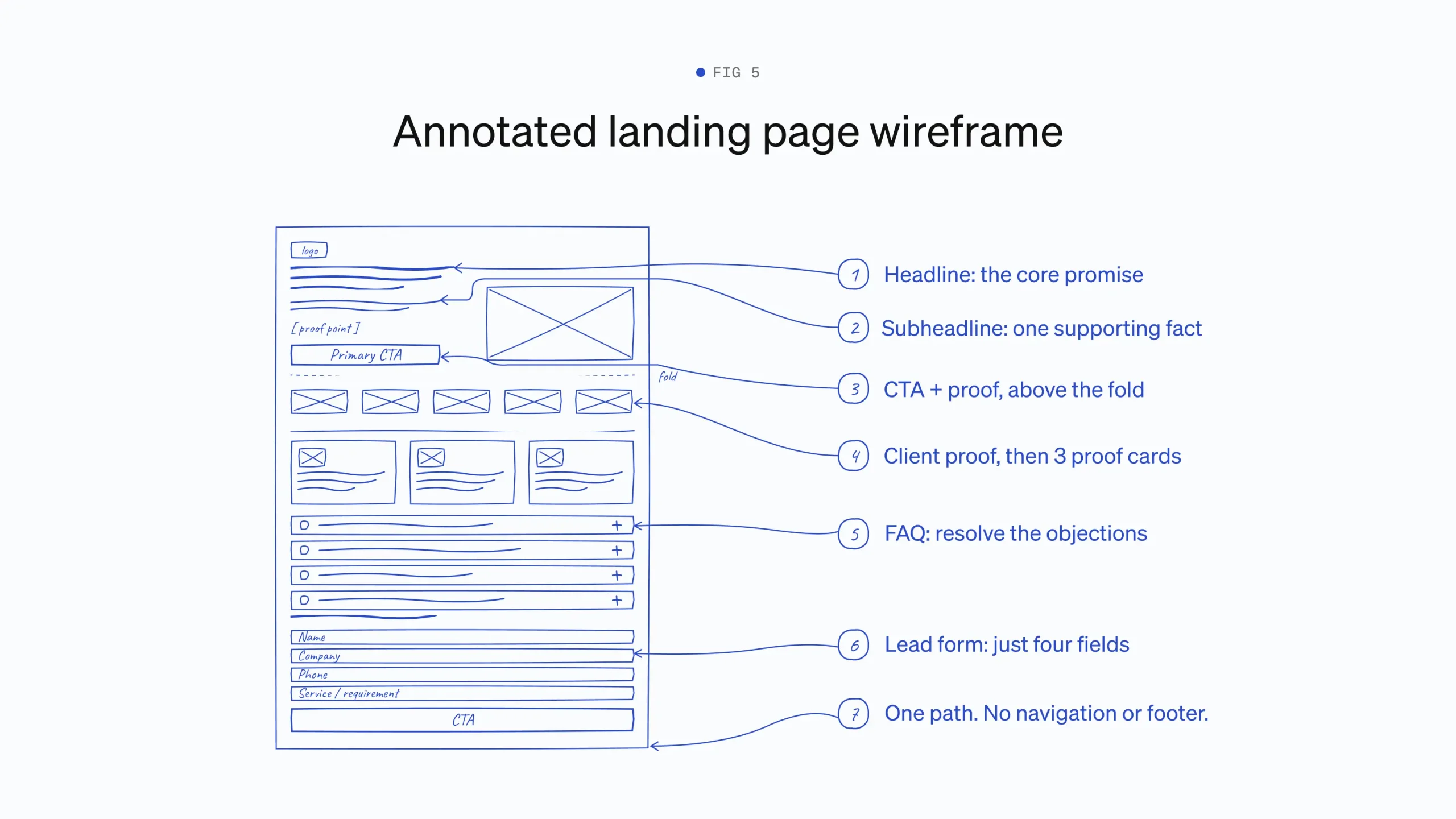
Page length is decided by the size of the decision, not by a rule. A request for a free quote on a needed repair supports a short page: headline, proof, objections, form. A request to book a consultation about outsourcing a company’s accounts supports a longer one, because the visitor has more to lose and more questions to settle. Write the sections the decision requires and stop. If a section does not answer a question a real buyer asks, it is padding.
Remove more than you add. Take off the navigation bar, because every link is an exit. Take off the footer link list for the same reason, keeping only the legal pages. Remove sliders and carousels, which hide most of their content from most visitors. Remove stock photography, which proves nothing. Remove any claim you cannot support with a fact on the same page. The finished page should contain one action and no alternatives to it.
On a phone, the page has to survive different behaviour. A phone visitor is more likely to be interrupted, more likely to want to call rather than type, and sees one section at a time rather than a whole screen. Make the phone number a tap-to-call link. Check that the headline does not wrap into six short lines, that the button is large enough to hit with a thumb, and that the form fields trigger the right keyboard, meaning the email field brings up the keyboard with the @ symbol and the phone field brings up the number pad. Button size and placement are not a matter of taste, as how Fitts’s law applies to buttons and calls to action sets out: bigger, closer targets get hit more often and with fewer errors. Test the page on a real phone over a mobile connection, not only in a desktop browser’s phone preview, because the preview does not show real load times.
Speed has published thresholds, so use them. Google’s Core Web Vitals define a good Largest Contentful Paint, the moment the main content appears, as within 2.5 seconds. Google’s 2017 research with SOASTA found that as mobile load time grows from one second to three, the probability of the visitor leaving rises by 32 per cent. Deloitte’s 2020 study with Google, Milliseconds Make Millions, measured the commercial effect of improvements as small as a tenth of a second. The figures and what they mean for a small B2B site are set out in how page speed affects conversion, according to Google and Deloitte. For a one-page site the causes of slowness are few: oversized images, too many scripts, and cheap hosting. Compress every image, load no script you cannot name a reason for, and test with PageSpeed Insights before the campaign starts, not after.
How to write the form
Every field on a form costs you completed submissions, so every field must pay for its place. The Baymard Institute, which has studied checkout and form behaviour since 2009, finds that most forms carry roughly twice as many fields as the transaction needs, and that each unnecessary field adds effort, hesitation and errors. Their checkout findings transfer to lead forms more directly than most people expect, a case made in what Baymard’s checkout research means for B2B lead forms, with the practical application covered in how to use Baymard Institute findings to improve your forms.
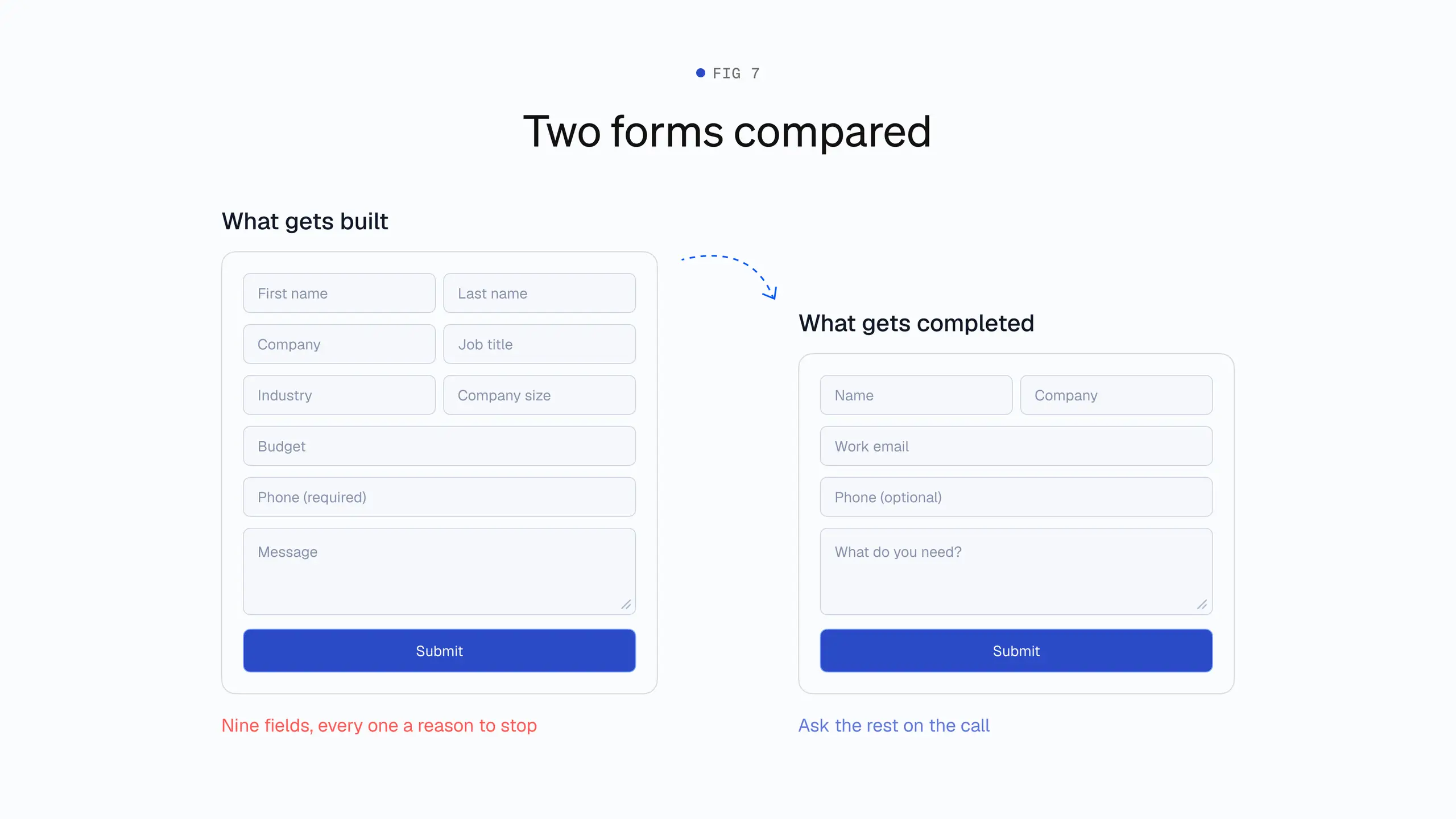
Four fields is the right starting point for a small company: name, company, work email, and one open message box. Everything else you can ask for on the phone. The question to put to each proposed field is not “would this be useful to know?” but “is this worth losing enquiries over?”. Budget dropdowns, industry pickers, company-size selectors and “how did you hear about us?” all fail that test for a company handling a handful of enquiries a week, because a person will learn all of it in the first five minutes of the reply call.
| Field | Recommendation | Reason |
|---|---|---|
| Full name | Keep, one field | Needed to reply like a person. Use one name field, not separate first and last, which doubles the typing and breaks for many real names. |
| Work email | Keep, required | The reply channel. Validate the format, accept any provider. |
| Company | Keep for B2B | Lets the replier prepare, filters consumer enquiries. |
| Message box | Keep, optional | The best qualification field there is. What someone writes tells you more than any dropdown. |
| Phone number | Optional field, or omit | Making it required costs completions. See below. |
| Budget dropdown | Omit | Enquirers either do not know or do not want to say. Ask on the call. |
| Company size, industry, job title | Omit | Learnable from the email domain and the call. Pure friction at this stage. |
| “How did you hear about us?” | Omit | Your conversion tracking already answers it more accurately. |
The phone number field is the genuine judgement call. The case for it: a phone number lets you reply by the fastest channel, and for urgent trades like the compressor example, the enquirer wants a call. The case against: a required phone field reads as “a salesperson will ring you”, and some visitors abandon the form rather than hand over their number. The resolution for most small companies is to include it as an optional field, marked “optional” in the label, with a line of microcopy underneath: “Only if you’d like us to call rather than email.” Those who want a call provide it. Those who distrust it skip it and still become enquiries.
Do not block free email addresses. Some form tools offer to reject gmail.com and similar domains on the theory that serious buyers use company email. For a small company this is usually a mistake. Sole traders, farmers, landlords, early-stage founders and plenty of engineers at small firms run their business from a personal address, and blocking them discards real buyers to filter out a nuisance that a human reading five enquiries a day can filter in seconds. Validate that the address is shaped like an address. Leave the judgement about its owner to the person replying.
Progressive profiling means asking for information across visits instead of all at once. The form asks four questions today. If the same person later downloads a guide or books a call, the next form asks two new questions instead of repeating the first four, and the record builds over time. Marketing platforms sell this as a feature. It matters for a company running many campaigns to thousands of contacts. For a company at the stage this guide addresses, it is a term to recognise, not a thing to build.
Validate inline and write error messages that say what to do. Inline validation means the form checks a field when the visitor leaves it, not after they press submit, so a mistyped email is flagged while their attention is still on it. An error state needs three properties: the failing field is marked at the field, not only in a summary at the top, the message names the problem in plain words, “This email is missing the part after the @” rather than “Invalid input”, and nothing the visitor typed is thrown away. These few words of interface text carry measurable weight, as how microcopy changes form completion rates sets out.
Label the submit button with what happens next, not with “Submit”. “Request a quote”, “Book a call”, “Send my enquiry”. The label is a promise, and it must match both the ad the visitor clicked and what your team will do with the submission, a matching problem covered in how to write calls to action that match buyer intent. A button that says “Get your free audit” followed by a generic sales call teaches the enquirer to distrust the next thing you say.
The thank-you page has three jobs. First, confirm the submission worked, naming what was sent and to whom. Second, set the expectation: “A person, not an autoresponder, will reply by tomorrow at 5pm.” Third, exist at its own URL, because that URL is what your conversion tracking counts. A form that shows an inline “thanks” message without changing the URL leaves you unable to attribute enquiries to keywords without extra tracking work. If there is one useful next step, offer it here: a spec sheet to download, or a direct line for urgent cases. One step, not a menu.
Double opt-in applies to marketing lists, not to enquiry replies. Double opt-in means a person who subscribes gets an email asking them to confirm before they are added to the list, which protects list quality and is standard practice for newsletters. Replying to a direct enquiry does not require it, since the person asked you to contact them. Where the line matters: if you plan to add every form submitter to an ongoing mailing list, say so at the form with an unticked checkbox, and use confirmed opt-in for that list. Consent rules differ by country, and the safe general posture is to reply to what was asked and to treat list-building as a separate, explicit permission.
Every public form gets spam, so plan for it before launch. Bots crawl the web submitting forms with gibberish, scam offers and link lists, and a new form can receive more bot submissions than human ones. The first defence is a honeypot: an extra field hidden from human visitors by the page styling, which bots fill in because they read the code rather than the screen. Any submission with that field filled is discarded. Honeypots cost visitors nothing and most form plugins include one, so switch it on from day one. The second defence is a challenge service such as Cloudflare Turnstile, which, as of 2026, is free and checks the visitor’s browser behaviour in the background, showing a puzzle only when something looks automated. Add Turnstile or an equivalent when spam gets past the honeypot in volumes that waste real time, and prefer it to older visible puzzles that make humans prove themselves before the bots do. Whatever you add, submit the form yourself from a phone afterwards, because an anti-spam measure that blocks a real enquirer is more expensive than the spam it stopped.
Where the traffic comes from
Every lead channel trades money, time and attention in a different ratio, and the right channel for your company depends on which of the three you have spare. There is no best channel. There is a channel that fits your buyer, your price point and your capacity to keep at it. The map below covers the twelve that matter for B2B, with the honest version of what each one costs and how each one is most often done badly.
Organic search. Costs time rather than cash, unless you pay someone to do the work. Expect six to twelve months before it produces a steady flow of enquiries. It suits companies whose buyers type their problem into Google, which covers most services and most software. The most common failure is writing pages about the company instead of pages about the things buyers search for.
Paid search. Costs per click, and B2B clicks are among the most expensive because every competitor wants the same handful of commercial terms. It can produce a first lead within days, which makes it the fastest channel on this list. It suits companies with a clear commercial search term and enough margin per sale to pay for the clicks that do not convert. The most common failure is sending every click to the homepage and never setting up conversion tracking, so the budget burns without anyone learning anything.
Paid social. Costs per impression or per click, with LinkedIn the expensive option and Meta the cheap one. First leads arrive in days to weeks, though B2B leads from social are colder than search leads because nobody was looking for you. It suits companies that can define their buyer by job title or industry, and products that can be shown or explained in a few seconds. The most common failure is targeting too broadly and judging the channel on one creative before testing a second.
Organic social. Free in cash and expensive in time. It takes months of consistent posting before anyone outside your existing contacts sees your posts. It suits founders and consultants who will write under their own name, because personal accounts reach far more people than company pages do. The most common failure is posting company announcements from a company page, which is content nobody followed you to read.
Email. Costs a few hundred rupees a month for the software, plus the time to write. It produces nothing until you have a list, and building a list takes as long as building any audience. It suits any company with a long sales cycle, because email keeps you in front of people who are not ready yet. The most common failure is buying a list, or writing to your list only when you want something from it.
Referral and partnerships. Costs relationship time, and sometimes a referral fee. Slow to start, because a partner has to trust you before they will attach their name to you, but the leads that arrive are the warmest of any channel. It suits services with natural neighbours, an accountant and a bookkeeper, a designer and a developer. The most common failure is expecting referrals without ever sending any, and never telling partners what a good fit for you looks like.
Directories and marketplaces. Cost a listing fee, a subscription or a commission per job. They can produce leads within weeks because the directory already has the traffic. They suit services buyers compare side by side, and new companies with no other source of enquiries. The most common failure is a skeleton profile with no reviews and no photos, followed by the conclusion that the directory does not work.
Outbound. Costs time, or a salary plus tools if you hire for it. A well-built list and a specific message can produce replies within weeks. It suits companies with a high order value and a buyer you can name, a job title at a type of company in a region. The most common failure is choosing volume over relevance and sending the same template to two thousand people, which gets the domain flagged and the sender ignored.
Events and trade shows. The highest cash cost per lead on this list once you count the stand, the travel and the days out of the office. The leads arrive on one date, then nothing until the next event. They suit considered purchases where the buyer wants to meet a person before spending. The most common failure is collecting badge scans and never following up, which is common enough that following up within a week is a competitive act.
Community and forums. Free in cash and heavy in time. It takes months of answering other people’s questions before anyone checks who you are. It suits narrow expertise, the person who knows one topic deeply and can prove it in public. The most common failure is joining to promote, which every community recognises within two posts and punishes with removal.
PR and earned mentions. Costs time, or a retainer if an agency does the pitching. The output is unpredictable, months of nothing and then one mention that refers buyers for years. It suits companies with data, a contrarian position or a story a journalist can use. The most common failure is issuing press releases about things only the company cares about, a new hire, an office move, an anniversary.
Word of mouth. Costs nothing directly. It is bought with the quality of the work and it is the slowest channel here, measured in years. It suits every company and it is a plan for none, because you cannot schedule it. The most common failure is treating it as luck. A satisfied client who is asked, once, plainly, to pass your name to one other person will often do it. A client who is never asked rarely thinks to.
| Channel | Time to first lead | Cost | Effort to maintain | Who it suits |
|---|---|---|---|---|
| Organic search | 6 to 12 months | Time, or an agency fee | Medium, ongoing | Anyone whose buyers search |
| Paid search | Days | High per click in B2B | Medium, weekly review | Clear commercial terms, decent margin |
| Paid social | Days to weeks | Medium, per impression | High, creative wears out | Definable audience, showable product |
| Organic social | Months | Time only | High, several posts a week | Founders posting as themselves |
| Only once a list exists | Low software cost | Low to medium | Long sales cycles, repeat buyers | |
| Referral and partnerships | Months | Relationship time | Low once built | Services with adjacent trades |
| Directories and marketplaces | Weeks | Listing fee or commission | Low | Comparable services, new companies |
| Outbound | Weeks | Time, or salary plus tools | High, constant | High order value, nameable buyers |
| Events and trade shows | On the day | High cash cost | Bursts around each event | Trust-heavy considered purchases |
| Community and forums | Months | Time only | Medium, ongoing presence | Narrow, provable expertise |
| PR and earned mentions | Unpredictable | Time, or a retainer | Low between pushes | Companies with a story or data |
| Word of mouth | Years | The quality of the work | None, but ask for it | Everyone, as a by-product |
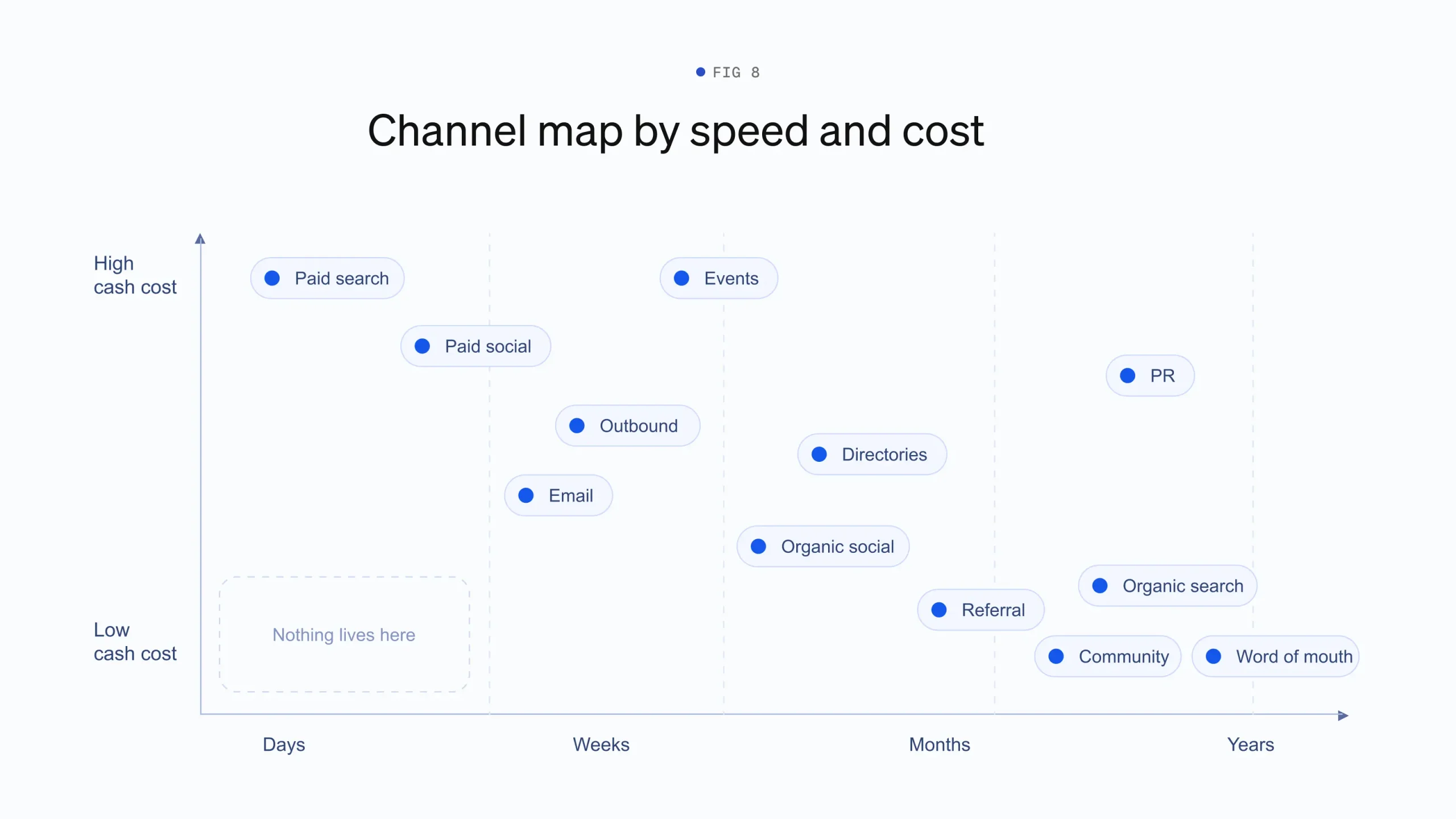
Run one or two channels well rather than eight badly. Every channel on this list rewards consistency and punishes dabbling, and a small company has perhaps ten hours a week for all of this combined. Ten hours spread across six channels produces nothing measurable in any of them. The same ten hours on one primary channel and one supporting one, held for two quarters before judging the result, is the plan most small companies should run. Pick the channel where your buyers already are, not the one you find most comfortable.
Search as a lead channel
Organic search is the one channel that brings you buyers at the moment they are looking for what you sell, and it charges you in months rather than money. For a new site with no history, expect six to twelve months of steady work before enquiries arrive with any regularity, and treat anyone who promises faster with suspicion. A site with a few years of history and some existing rankings can see movement in two to three months. This section is what to do with those months.
Find the terms buyers use, not the terms you use
Buyers search in their own words, and those words are rarely yours. A firm that sells “managed IT services” is searched for by people typing “IT support for small business” or “someone to fix our server”. The gap between the seller’s vocabulary and the buyer’s vocabulary is where most small-company SEO fails before it starts.
Three sources tell you the real words. First, ask new clients what they typed when they found you, or would have typed if they had searched. Second, type your service into Google and read the autocomplete suggestions and the “People also ask” boxes, which are drawn from real queries. Third, read your own enquiry emails and sales call notes, because the phrasing a buyer uses in an email is the phrasing they use in a search box. Write these down as exact phrases. A list of thirty real phrases beats any keyword tool subscription for a company at this stage.
Commercial intent and research intent
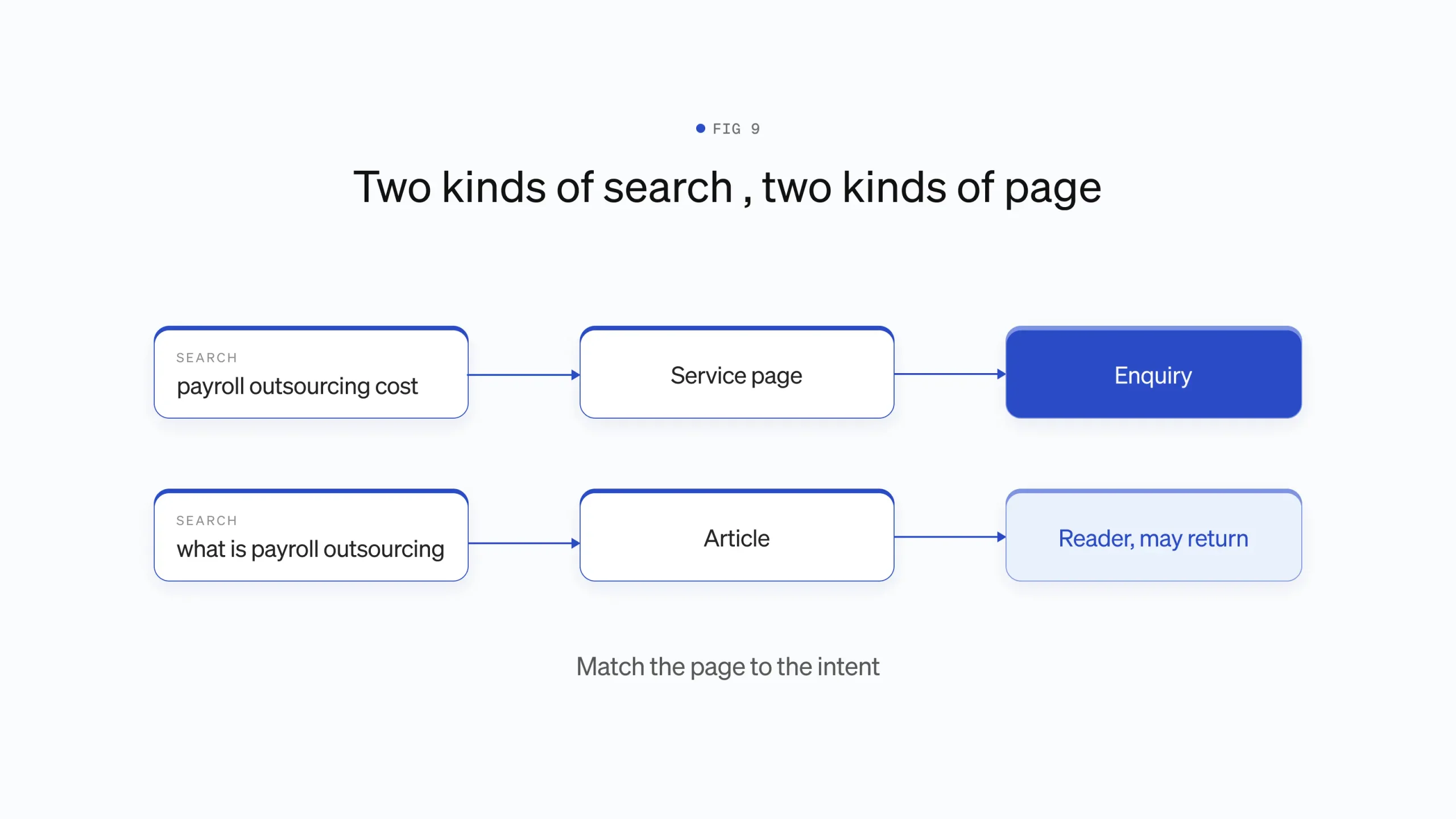
Every search is one of two kinds, and the difference decides everything you build. A commercial-intent search is typed by someone preparing to buy: “payroll outsourcing cost”, “ERP implementation partner Kochi”, “hire fire safety consultant”. A research-intent search is typed by someone trying to understand something: “what is payroll outsourcing”, “ERP vs accounting software”. Commercial searches are a small fraction of all searches and produce nearly all the enquiries. Research searches produce readers, some of whom become buyers later, most of whom do not.
Serve commercial intent with service pages and serve research intent with articles. Sending a commercial searcher to a blog post loses the enquiry, and pointing a service page at a research phrase gets the page ignored, because Google matches the type of page to the type of query. Sort your list of thirty phrases into the two piles before you write anything.
Why the smaller term is often worth more
A low-volume term you can rank for beats a high-volume term you cannot. The broad term for your category is contested by every large competitor and by publishers who write about it for advertising revenue, and the people typing it are mostly researchers, students and competitors. The narrow term, your service plus an industry, a place or a specific problem, has a handful of searchers a month, and several of them are buyers with that exact need. Ten narrow pages that each bring one enquiry a month outperform one broad ranking that brings none. This is the single most useful reframing for a small company: stop asking how big the term is and start asking who is typing it.
Google Business Profile for companies that serve a place
If your buyers are in your city, the map results matter as much as the ordinary ones. Searches with local intent show a map with three businesses above most of the normal results, and a Google Business Profile is how you appear there. It is free. Claim it at google.com/business, verify by the method Google offers you, usually video or post, and then complete every field: categories, services, opening hours, photos of real work and real people. Ask each satisfied client for a review, one at a time, by sending the direct review link. Profiles with recent reviews and complete fields appear more often, and a profile abandoned after setup slides out of the map pack within months. Buyers comparing local firms read these profiles the way they read shortlists, a behaviour covered in more depth in how to choose a web design company in Thiruvananthapuram.
What a service page needs to rank and convert
One page per service, named in the buyer’s words. The page needs a heading that matches the commercial phrase, a first paragraph that says who the service is for and what it costs or how pricing works, evidence in the form of named work or specific results, answers to the questions buyers ask on calls, and one clear way to enquire. A page listing six services in one place ranks for none of them. The full anatomy is covered in how to structure a services page for companies that sell expertise, and it applies whether you sell consulting, software implementation or design.
Technical basics that matter, and the ones that do not
Four technical things are worth your attention. Speed, because slow pages lose visitors before the content loads, and Google measures this through the metrics described in what Core Web Vitals measure and why buyers feel them. Mobile rendering, because Google indexes the mobile version of your site and a large share of B2B research happens on phones. Crawlability, meaning nothing blocks Google from reaching your pages: no accidental noindex tags, no login walls in front of public content, a sitemap submitted. And structured data, the machine-readable labelling explained in how structured data helps machines read your website, which helps search engines understand what your organisation and pages are. You can check most of this yourself in a few hours by following how to audit your website’s performance in one afternoon.
Several things that agencies sell are not worth paying for. Meta keywords have been ignored by Google since 2009, by Google’s own statement. Keyword density targets are a relic. Publishing daily has no value in itself. Domain-level scores from third-party tools are that tool’s estimate, not a number Google uses. If a proposal is built around these, keep your money.
Check what you rank for now
Google Search Console is Google’s free report of your own search presence, and it is the first tool to set up because it shows real queries, not estimates. The steps:
- Go to search.google.com/search-console and sign in with a Google account.
- Choose Add property. Pick URL prefix and enter your full address, for example https://yourcompany.com.
- Verify ownership. The HTML tag method is the easiest on WordPress: copy the meta tag Google shows you and paste it into your site’s header through your SEO plugin’s verification field, then click Verify.
- Wait a few days for data to gather, then open Performance in the left menu.
- Read the Queries table. It lists the phrases you appeared for, with clicks, impressions and average position. Set the date range to the last three months.
- Look for queries with many impressions, few clicks and a position between 8 and 20. These are terms where Google half-trusts you, and improving the matching page is the cheapest ranking gain available to you.
Repeat the check monthly. Position moves slowly, and the habit of reading real query data cures most of the guesswork that makes this channel feel like a lottery.
Content that brings buyers who are already looking
Content produces enquiries when it answers questions that buyers ask on the way to a purchase, and it produces only traffic when it answers anything else. The difference is not quality of writing. A well-written article on the wrong question brings readers who were never going to buy. This section is how to plan for the first kind.
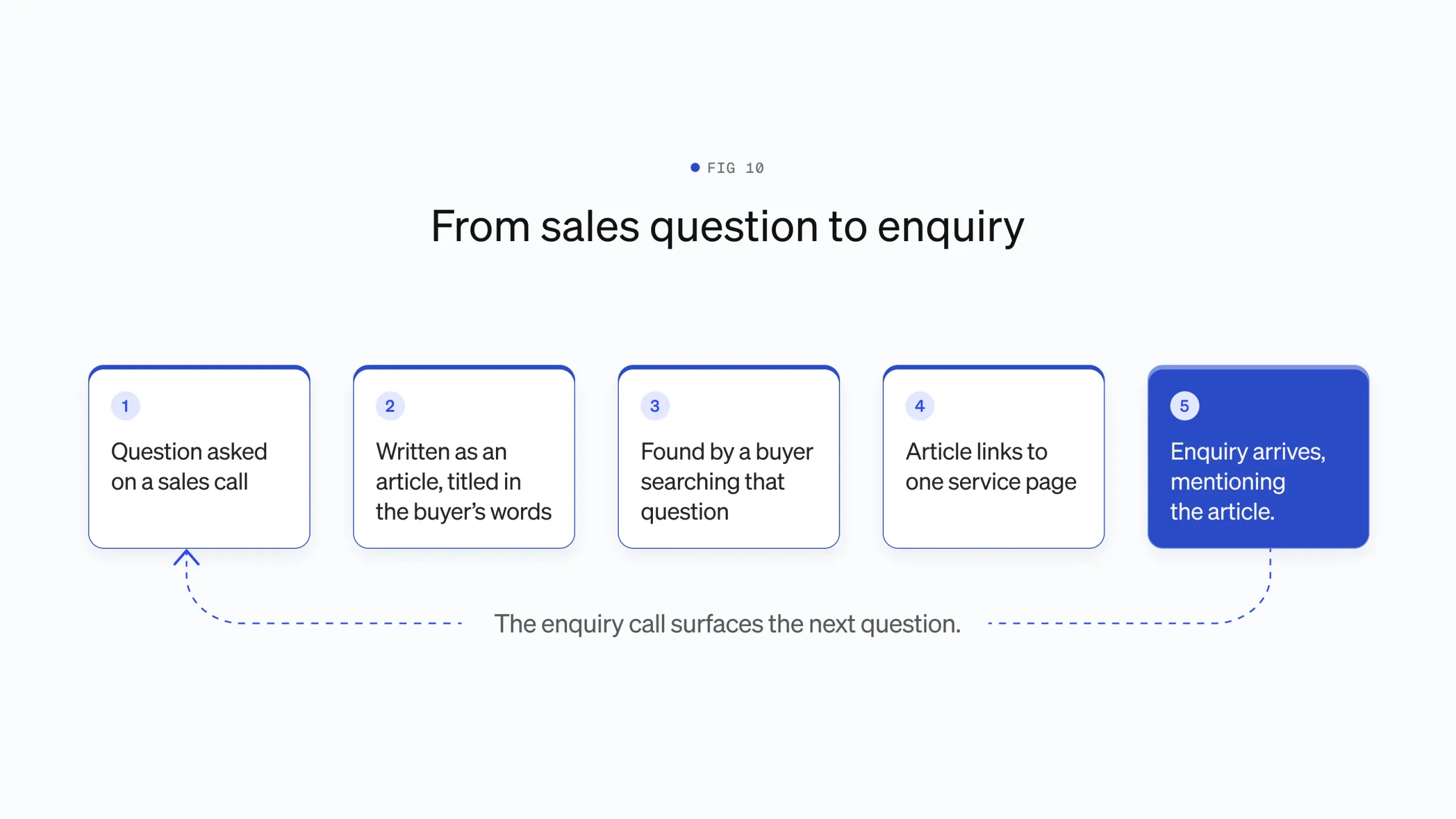
Start from the questions sales already answers. Every question a prospect asks on a call is a question other prospects are typing into Google, and the answer your best salesperson gives is already better than what most competitors have published. Collect these questions for two weeks, from calls, emails and meeting notes, and you will have a content plan that no keyword tool can match, because every item on it is a question asked by someone with money in hand. The full method is in How to plan content around the questions sales answers every week.
Know whether you are writing for buyers or for peers. Content about industry trends, opinions on your craft and commentary on other providers attracts other people in your industry. They will read it, share it and compliment you on it, and none of them will ever buy. Content about the buyer’s problem, what the work costs, how long it takes, what goes wrong, how to choose a provider, attracts the people who pay. Peer content has a place, it builds referral relationships, but count it as the referral channel, not the content channel, and keep it under a quarter of what you publish.
Most company blogs fail for reasons that are visible in advance. They publish company news nobody searches for. They chase broad topics already covered by a hundred larger sites. They stop at the sixth article, months before the channel could have shown anything, because nobody assigned the work to a named person with protected hours. And they connect to no offer, so even a reader who loved the article has nowhere obvious to go. Every one of these is a planning failure, not a writing failure.
Set the expectation before you start: this takes a year to compound. A realistic plan for a small company is two articles a month, held for a year, which is twenty to twenty-five published pieces. The first enquiries usually arrive earlier than the twelfth article if a few early pieces match commercial questions, but the steady flow, where the site produces enquiries in weeks when you published nothing, arrives after the corpus has built and aged. Companies that quit at month four have paid most of the cost and collected none of the return. If your industry moves fast enough that articles feel stale in months, write them the way described in How to write evergreen content in a fast-moving industry, anchoring each piece in the decisions buyers face rather than in this quarter’s product names.
Link every article to one offer. An article with no next step is a dead end, and an article with six next steps is a corridor of doors. Each piece should end with the one service page or one action that fits the question it answered. An article on the cost of a service links to that service’s page. An article comparing approaches links to a consultation. Write the next step as a plain sentence, not a banner, because the reader who has just had a question answered well is the reader most willing to take it.
After the first year, refreshing beats publishing more. An article that reached position nine is closer to producing enquiries than a new article at position ninety, and updating it, better answers, current details, a clearer next step, moves it further than a new piece moves from nothing. Once you have twenty pieces, spend every third writing session updating the existing ones that Search Console shows on page one or two. This is the least glamorous work in the whole channel and it has the best return per hour.
A worked example, from question to enquiry
Take a payroll outsourcing firm whose salesperson reports that almost every call includes the question, “what happens to our data if we stop using you?” That is a buyer’s question. Nobody researching payroll as a topic asks it. Only someone deciding whether to sign asks it, and the fear behind it, being locked in, is the real obstacle to the sale.
The firm writes one article titled with the question as buyers phrase it, “What happens to your payroll data when you switch providers”. It gives the honest answer: the format the data is exported in, who owns it, the notice period, the two weeks a handover takes, and the one thing that goes wrong when the old provider drags its feet. It ends with a single sentence: if you are weighing a switch, the firm’s payroll service page explains how its own exit terms work, with a link.
Months later, an operations manager at a forty-person company, unhappy with her current provider and worried about exactly this, types the question into Google. The article answers it without asking anything of her. The candour about exit terms is itself the persuasion, because it signals a firm that does not need to trap its clients. She clicks through to the service page and sends an enquiry that opens with, “I read your piece on switching”. One question, one article, one enquiry, and the article keeps doing this for years while the firm writes the next one.
Paid search and paid social
Paid search and paid social answer different questions. Search shows ads to people who typed a problem into Google, so it measures demand that already exists. Social shows ads to people who fit a profile, so the ad has to supply the reason to care. A business people search for by name or by problem tests search first.
A first search campaign is small and deliberately rigid. Two or three ad groups each hold a single theme: 5 to 15 closely related keywords in phrase and exact match, and one responsive search ad pointing at the most specific relevant page rather than the homepage. Conversion tracking on the form’s thank-you page is built and tested before launch. Two defaults get switched off: broad match, which hands targeting to Google’s guesswork before the account has history, and the search partner and Display networks, which add cheap clicks of low intent. A negative keyword list goes in on day one: free, jobs, courses, templates, and the services the business does not offer.
The budget decides whether the test can be read at all. The working rule is enough daily spend to buy 30 clicks a week. Check the typical cost per click in Keyword Planner and work backwards: at ₹200 a click, that is a floor of about ₹860 a day. Bidding starts manual, with a cost-per-click ceiling, and moves to an automated strategy only after 20 to 30 recorded conversions, because automated bidding with no history overpays for guesses.
LinkedIn sells precision and Meta sells reach, and deal size picks between them. LinkedIn targets job title, seniority, company size and uploaded company lists, at click prices several times what other platforms charge, a trade that works for considered purchases worth ₹8 lakh or more with a narrow, senior audience. Meta has no dependable job title data but far lower click costs, so it suits business purchases made by one person: the sole trader, the clinic, the local firm. On either platform, retargeting past visitors is the cheapest audience available, with a frequency cap set and past enquirers excluded.
A campaign that does not work breaks at one stage, and each stage has its own fix. No impressions is administrative: a paused status, an ad stuck in review, billing, or bids below the first page. Impressions without clicks means the ad does not match what people wanted. Clicks without form submissions means checking the tracking first, then the landing page, starting with whether the page repeats the promise the ad made. Enquiries from the wrong people point to targeting or to a hidden price. Qualified leads that do not become sales point past the campaign, to response speed and follow-up.
Targeting problems and message problems leave different fingerprints. Wrong people arriving at the top of the funnel is targeting, visible in the search terms report and in who the leads turn out to be. The right people declining to click, or clicking and leaving within seconds, is the message. Investigate targeting first, then message, then the page, one change at a time, with around 100 events before reading each result.
These rules are enough to launch, and the detail sits in the full article. How to run paid search and paid social for a B2B business adds the click-by-click setup sequence with the interface names as they appear in 2026, a worked example of the three match types, guidance on ad copy and assets, the minimum budgets for LinkedIn, and the full funnel diagnostic with the sample sizes each verdict needs.
Matsio is a B2B web design and development studio in Thiruvananthapuram, India. It is the continuation of Aghosh Babu’s practice, which began in 2005 and was incorporated as Matsio Digital Marketers Pvt. Ltd. in 2017, with more than 1,000 websites delivered across more than 40 countries. Most of the lead generation work the studio is asked for arrives as a redesign request, and the first task is usually to find out whether the site is the part that is failing. In a fair number of cases it is not, and the money is better spent on the offer or on the follow-up than on a new set of pages. 85% of the studio’s clients return for further work, measured across every engagement since 2005.
Channels beyond search and social
Some buyers never arrive through search or social at all. They message a supplier on WhatsApp, ask an AI assistant for a shortlist, or find a firm through a directory, a forum or a colleague’s referral. Each channel below carries fewer enquiries than the large platforms, but enquiries the large platforms never would.
WhatsApp is a working lead channel in India, the Gulf, Latin America and South East Asia. Buyers there message a supplier before they would email one, and expect a reply within the hour during business hours. The channel demands three things: someone assigned to answer fast, a number owned by the company rather than an employee, and every promising conversation copied into a CRM, because a chat is not a lead record. One or two people can run the free WhatsApp Business app. Teams need the paid API platform, which supports many agents on one number and connects to a CRM.
Appearing in AI assistant answers is a content and structure problem, not a media buy. When a buyer asks an assistant for vendors, the answer names a handful of companies chosen from the sources the assistant retrieves, not from an auction. Advertising on these surfaces exists in early forms and changes month to month, so check each platform’s own documentation before planning spend. The durable work is open to any company now: plain pages that state what you do, for whom and at what price shape, written so a machine can quote them. The assistant does not weigh your ad budget, which makes this one of the few surfaces where a small company competes level.
A set of smaller channels each suits a narrow kind of business. Directories and review sites suit categories buyers compare, such as software and agencies. Forums and private communities suit technical products whose buyers distrust marketing, and pay back slowly, through being useful under your own name. Newsletter sponsorship and podcast guesting suit audiences defined by role or industry. YouTube suits products that show well on a screen. Referral partnerships suit firms with natural neighbours who serve the same customer before or after them. Test one at a time, over a defined period, with a way to count what it produced.
AI helps where the task is bounded and a person checks the output. Drafting ad variations, researching prospects, summarising calls into the CRM, routing enquiries: it does all of these well under supervision. It does not write content that persuades on its own, it cannot score leads without your history of which deals closed, and it does not stand in for the first conversation. Mass personalised-looking outbound is the trap: volume without judgement about recipients is spam whatever wrote it, and it damages the sending domain that good email needs.
The full article carries the working detail. Lead generation channels beyond search and social adds what this summary leaves out: the app-versus-API decision and WhatsApp’s template and opt-in rules, which AI advertising formats had shipped at the last update, starting steps and the usual failure mode for each of ten smaller channels, and the specific list of AI uses worth adopting.
What happens after the form
Work out the most you can pay for a lead before you buy any. The arithmetic takes three numbers. Take a consultancy whose average project brings ₹8 lakh in fees and costs ₹3.2 lakh to deliver, leaving ₹4.8 lakh of gross profit. If it wins one deal from every five qualified leads, each qualified lead carries ₹96,000 of expected profit. Spending between a fifth and a third of that on winning the work gives a ceiling of up to ₹32,000 per qualified lead, and if only half of raw enquiries turn out to be qualified, up to ₹16,000 per raw enquiry. Every channel gets judged against those ceilings, not against the other channels.
Rank enquiries by fit and intent, held as two separate scores. Fit measures whether the company is one you serve. Intent measures whether the person is behaving like a buyer. Blending the two into one number hides which of them is missing, and the two gaps need opposite treatment: good fit without intent goes on a keep-in-touch list, and intent without fit gets a polite early no. Below roughly 50 leads a month, skip scoring altogether and read the enquiries yourself.
Reply within the hour, because the value of an enquiry decays from the moment it is sent. A 2011 study by Oldroyd, McElheran and Elkington, published in Harvard Business Review, audited 1.25 million web leads and found that firms making contact inside an hour were nearly seven times as likely to hold a qualifying conversation with a decision maker as firms that waited longer. The data is old and American, but the mechanism still holds. An hour after submitting, the person is engaged with the problem and has not yet approached a competitor.
Fill the first hour with two messages and one rule. An automatic acknowledgement goes out within a minute, naming who will reply and by when, from an address a person reads. A human reply follows inside the hour, quoting what the enquirer wrote and asking a single qualifying question. The rule is ownership: every submission has a named owner and a fallback who claims it if it sits untouched for 15 minutes. After the first hour, attempts alternate between phone and email until day 10, then a closing note and a move to the nurture list. Four or five attempts is the limit.
A nurture sequence works when it gives more often than it asks. Sequences fail when every message pitches, because the reader concludes that none of the messages are for them. A workable ratio is four useful messages for each ask, with the gaps widening from a week to three, segmented by what the person did rather than by their job title. Judge each message on replies, clicks and unsubscribes. Open rates have overstated attention since Apple’s Mail Privacy Protection began preloading messages in 2021.
Deliverability is set up once and decides everything after. SPF, DKIM and DMARC records at your domain registrar have been required by Google and Yahoo for bulk senders since February 2024. Cold outreach should never share a domain with client email, because spam complaints attach to the sending reputation of the whole domain.
The full article on what happens after someone fills in your form adds what this summary cannot hold: a scoring table with point values and thresholds, the negative signals that filter out students and competitors, the message-by-message contact sequence with its timings, a worked five-message nurture sequence over eight weeks, and the re-engagement and list-cleaning rules that keep a list deliverable.
How to measure lead generation
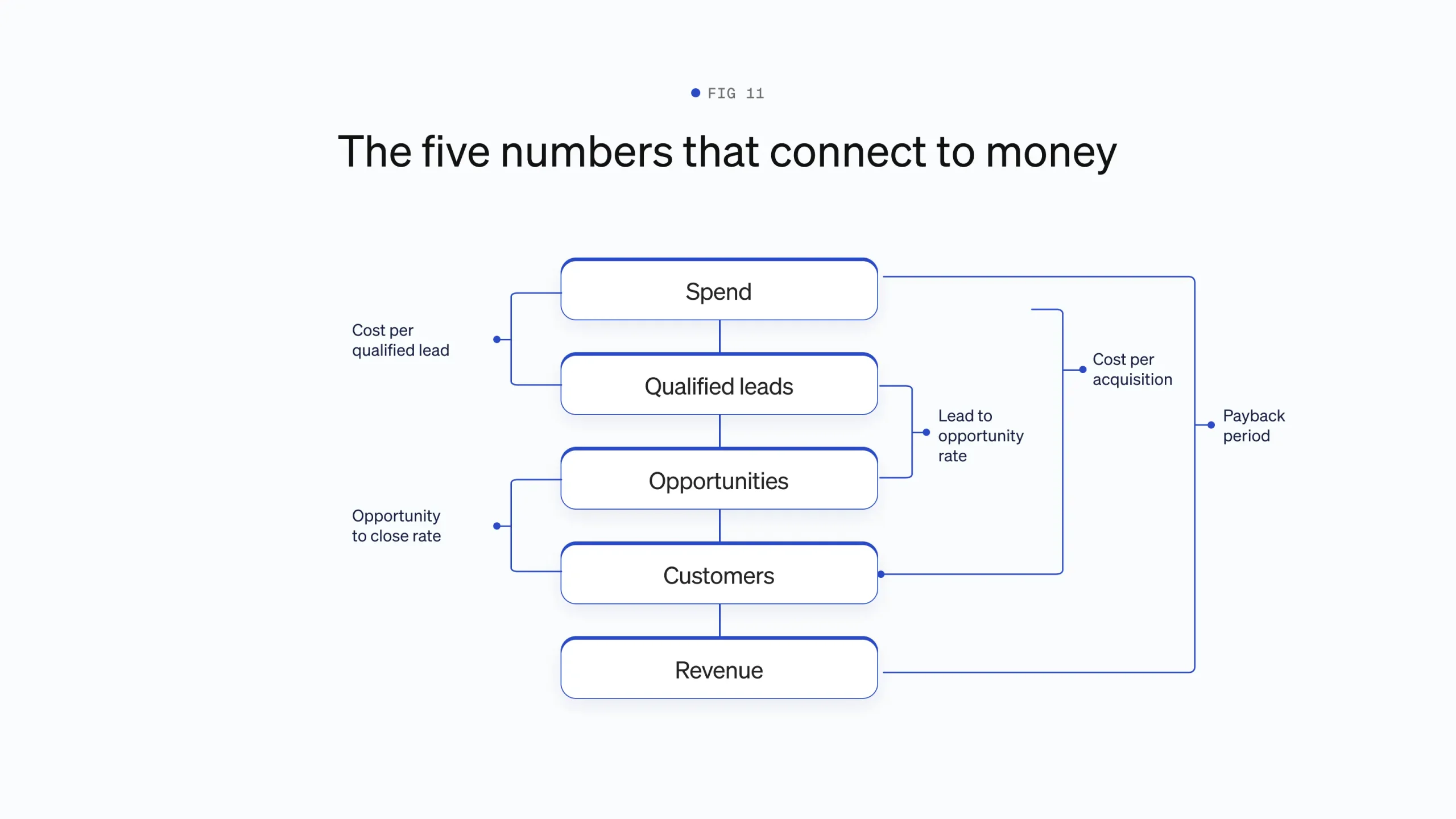
Measure the numbers that connect to money, and treat everything else as background noise. A lead generation programme produces five numbers worth tracking, and each one answers a question the business cares about. Most reporting dashboards show none of them.
- Cost per qualified lead. Total spend on a channel in a month, divided by the number of enquiries from that channel that fit your customer profile. Not all enquiries. Qualified ones. A channel that produces 40 enquiries at €10 each, of which two are qualified, costs €200 per qualified lead, not €10.
- Lead to opportunity rate. Of the qualified leads, how many turn into a real sales conversation, a proposal, or a demo. This tells you whether the leads are as qualified as they look.
- Opportunity to close rate. Of the conversations, how many become customers. If this number is low, the problem is usually the offer or the sales process, not the marketing.
- Cost per acquisition. Everything you spent on marketing in a period, divided by the customers won in that period. This is the number to compare against what a customer is worth.
- Payback period. How many months of revenue from a new customer it takes to recover the cost of acquiring them. A consultancy with large project fees can tolerate a long payback. A low-priced subscription cannot.
The numbers that mislead
Raw traffic is not a result. A site can double its visitors and gain nothing if the new visitors are students, job seekers, or people in countries you do not serve. Impressions are weaker still. An impression means your ad or listing was rendered on a screen, not that anyone read it.
Bounce rate is usually misread. A visitor who arrives at an article, reads the whole thing, finds the answer and leaves has bounced. For informational pages, that is the page doing its job. Bounce rate only signals a problem on pages where the next step matters, such as a landing page whose purpose is to produce a form submission.
Conversion rate without qualification rewards the wrong behaviour. If you count every form submission as a conversion, the fastest way to raise the rate is to attract people who were never going to buy. Count qualified enquiries, and accept that the rate will look worse and mean more. Rankings have the same weakness. A first-page position for a phrase nobody searches, or one that produces no clicks, is a trophy, not a result. The studio’s article on what heads of marketing should measure on a B2B website goes through this selection in more depth.
Attribution, and why every model is wrong
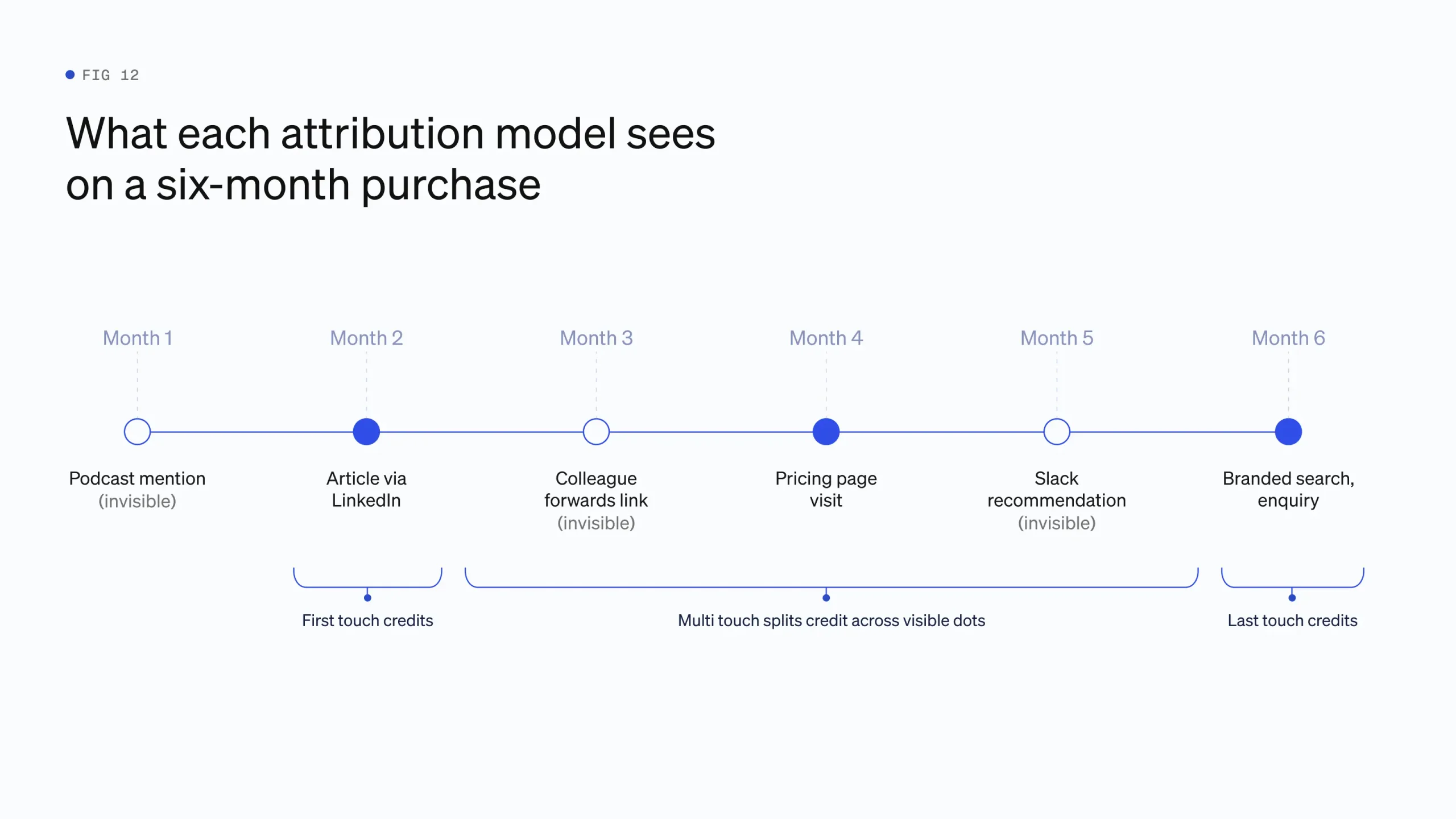
Attribution is the practice of deciding which marketing touch gets credit for a sale, and every standard model distorts the answer in a known direction. First touch credits whatever the buyer saw first, which flatters awareness channels and ignores everything that closed the deal. Last touch credits the final click before the enquiry, which flatters branded search, because a buyer who spent three months reading your articles will finish by typing your company name into Google. Multi touch spreads credit across recorded touches by a formula, which sounds fairer but only counts the touches the software can see, and assigns weights that are a modelling choice, not a measurement.
In a long sales cycle, the distortion grows. A B2B purchase decided over six months involves a podcast heard in a car, a recommendation in a private Slack group, a colleague forwarding an article, and a dozen visits from different devices. Analytics software sees a fraction of this. The unmeasurable portion is often called the dark funnel, and it is not an edge case. Some of what works in B2B cannot be measured, and a company that only funds what its software can attribute will cut its most effective channels. The studio has written about how to measure website contribution to revenue in long sales cycles, and about what repeat visitors tell you about pipeline, which is one of the few leading indicators that survives this problem.
Add one question to every form: “How did you hear about us?” Leave it as a free text field, not a dropdown. Self-reported attribution is imprecise, people misremember, and the answers need reading by a human. It is still more useful than it looks, because it captures the channels software cannot see. When a buyer writes “a colleague sent me your article on pricing”, no analytics tool would have recorded that, and it tells you which content to make more of. Read the answers monthly and tally them in a spreadsheet.
The minimum setup, step by step
For a small company, two free tools cover most of it. In Google Analytics 4, the work is to make your enquiry form count as a key event. Open Admin, then Data streams, and confirm Enhanced measurement is on. Send visitors who submit your form to a separate thank-you page, such as /thank-you/. In Admin, open Events, choose Create event, and define a new event that fires when page_location contains /thank-you/. Once it has recorded data, open the Events list and switch the “Mark as key event” toggle on for it. Reports will then show which channels produced enquiries, not only visits.
In Google Search Console, verify the site and submit the sitemap. At search.google.com/search-console, add your domain as a property and verify it with the DNS record the tool gives you, which your domain registrar’s control panel accepts as a TXT record. Under Sitemaps, submit the sitemap URL, on most WordPress sites /sitemap.xml or /sitemap_index.xml. Then use the Performance report monthly. Look at Queries sorted by impressions, and find phrases with many impressions and few clicks, which are pages ranking on the edge of usefulness and worth improving.
A spreadsheet beats a dashboard for the numbers that matter. Dashboards show what software can measure. The five money metrics need data no analytics tool holds: which enquiries were qualified, which became conversations, which closed, and what was spent. One spreadsheet row per month per channel, with columns for spend, enquiries, qualified enquiries, opportunities, customers and revenue, takes fifteen minutes a month to maintain and answers questions a dashboard cannot.
How long before a number means anything
Wait until you have counted at least 20 to 30 of the thing you are measuring. The reasoning is about sample size. Rare events arrive unevenly, so small counts swing hard. A channel that produces three leads one month and seven the next has not doubled, it has wobbled within the range that chance alone produces at those volumes. If your site converts around 1 in 50 visitors and gets 500 visits a month, you expect about ten enquiries, and month-to-month differences of four or five enquiries tell you nothing. At that volume, judging a change needs a quarter of data, not a month. For close rates the wait is longer still, because a company that wins two deals a month needs most of a year before a change in the rate is distinguishable from luck. Decide the review period before you start, write it down, and resist reading the numbers weekly.
Consent, data protection and the rules that apply
The rules on collecting and using contact details are manageable for a small company, and most of them reduce to telling people what you will do with their details and then doing only that. What follows is a description of the main regimes, not legal advice. A company with real exposure, large lists, sensitive data, or operations across several countries, should take advice from a lawyer in the relevant jurisdiction.
Consent on a form comes in two kinds, and the difference matters. When someone fills in your enquiry form, replying to their enquiry needs no separate permission. They asked you a question. Adding that person to a marketing newsletter is a different use of their details and needs its own consent, usually an unticked checkbox with a plain label such as “Send me the monthly newsletter”. Pre-ticked boxes do not count as consent under European law, and bundling marketing consent into the act of enquiring is the most common mistake on B2B forms.
GDPR applies if you have European contacts, wherever your company sits. The EU General Data Protection Regulation, in force since 2018, requires a lawful basis for each use of personal data, and for B2B marketing the two that matter are consent and legitimate interest. Legitimate interest lets you process data without consent where the use is one the person would reasonably expect and their interests are not overridden, and regulators have accepted that relevant, work-related contact by one business to another can qualify. It is not a blank cheque. You must be able to show you weighed the person’s interests, you must say in your privacy notice that you rely on it, and you must stop when asked. GDPR also grants rights to access, correct and delete data, which in practice means you must be able to find and remove a person’s details when they ask.
India’s Digital Personal Data Protection Act, passed in 2023, sets out similar duties in a shorter form. A company collecting details on a website must give notice of what is collected and why, obtain consent for uses beyond what the person asked for, keep the data secure, and delete it when the purpose is served or consent is withdrawn. The Act applies to digital personal data processed in India and to processing outside India connected with offering goods or services to people in India. Its detailed rules have been arriving in stages, so a company operating in India should check the current position rather than rely on a summary written earlier.
CAN-SPAM, the United States email law from 2003, is permissive by comparison. It does not require consent before a commercial email. It requires that you do not use false headers or deceptive subject lines, that you identify the message as an advertisement where applicable, that you include a physical postal address, and that you honour unsubscribe requests within ten business days. This is why cold email to American companies is lawful when done to the letter, while the same email to a German sole trader may not be.
Cold email rules differ by country, and the country that matters is the recipient’s. In the United States, CAN-SPAM applies as above. In the United Kingdom, the Privacy and Electronic Communications Regulations permit unsolicited email to corporate addresses, though GDPR duties still attach to the personal data involved. Across the EU, the ePrivacy rules are implemented country by country, and several countries treat unsolicited B2B email as requiring prior consent. Canada’s CASL requires consent with narrow exceptions and carries large penalties. If you run cold outreach, segment your list by country and apply the strictest rule that touches each segment.
Cookie consent changes what your analytics can see. Where consent banners are required and visitors decline, your analytics tool records nothing for those visitors, and reported traffic drops even though real traffic has not. Expect the gap between real and recorded visitors to be material, and treat analytics figures as a sample rather than a census. This is one reason the spreadsheet of enquiries matters more than the traffic graph, and it is the subject of the studio’s article on how privacy-first measurement works. The same pressure is pushing B2B companies towards data people hand over knowingly, which the studio covers in how first-party data shapes B2B marketing.
A retention policy is a written decision about how long you keep data, and every regime above expects one. The principle is the same everywhere: keep personal data only as long as the purpose requires. A workable small-company policy fits on one page. Enquiries that go nowhere are deleted after a stated period, such as two years. Newsletter subscribers are kept until they unsubscribe. Customer records are kept for the period tax law requires. Write it down, put a calendar reminder on it, and delete on schedule.
The privacy notice linked from a form must say five things. Who you are, what you collect, why you collect it and on what basis, how long you keep it, and how to ask for it to be corrected or deleted, with a contact address. Plain language is a requirement, not a courtesy. A clear notice also does commercial work. Research from Stanford’s Web Credibility Project, run by BJ Fogg’s lab in the early 2000s, found that visible signs of a real, accountable organisation are among the things visitors use to judge whether a site can be trusted, a finding the studio discusses in what the Stanford Web Credibility Project teaches B2B companies about trust. The same logic applies to the padlock, the certificate and the rest of the visible security surface, covered in how security signals affect B2B trust.
What this costs
The figures below are indicative ranges, not benchmarks. Published cost-per-lead benchmarks vary so widely by industry, country and survey method that they mislead more than they help, and none of them knows your deal size or your market. Use these ranges to budget, then replace them with your own numbers within two quarters. Figures are in US dollars for comparability and are what these things tend to cost as of 2026.
Three levels of spend
Level one is a one-person or small local business running the minimum viable setup. Tools cost ₹0 to ₹4,000 a month: a website on managed hosting, Google Analytics 4 and Search Console at no charge, a free-tier email tool, and a Google Business Profile. Media spend is ₹0 to ₹25,000 a month, and zero is a defensible choice at this level. Content production is done by the owner, one article or update a month. The real cost is time, 3 to 5 hours a week, and the budget decision is which 3 to 5 hours.
Level two is a growing company with a defined pipeline. Tools run ₹8,000 to ₹40,000 a month: a CRM on a paid tier, an email platform sized to the list, a scheduling tool, perhaps a keyword research tool. Media spend runs ₹40,000 to ₹2.5 lakh a month, concentrated on one paid channel rather than spread across three. Content production runs ₹40,000 to ₹2 lakh a month, whether paid to a freelance writer or counted as staff time. The time cost is 10 to 20 hours a week, usually a marketing hire spending half their week on it or an owner who has made it a standing part of theirs.
Level three is a company running several programmes at once. Tools run ₹40,000 to ₹2 lakh a month once a marketing automation platform, call tracking and reporting tools are in place. Media spend runs ₹2.5 lakh to ₹16 lakh or more a month across two or three channels. Content production runs ₹2 lakh to ₹8 lakh a month across writing, design and video. Time runs 40 or more hours a week, which is to say at least one full-time person, and usually a small team plus outside help.
| Cost line | Level one | Level two | Level three |
|---|---|---|---|
| Tools and subscriptions, per month | ₹0 to ₹4,000 | ₹8,000 to ₹40,000 | ₹40,000 to ₹2 lakh |
| Media spend, per month | ₹0 to ₹25,000 | ₹40,000 to ₹2.5 lakh | ₹2.5 lakh to ₹16 lakh+ |
| Content production, per month | Own time | ₹40,000 to ₹2 lakh | ₹2 lakh to ₹8 lakh |
| Person’s time, hours per week | 3 to 5 | 10 to 20 | 40+ |
Build, hire or agency
The decision turns on volume of work and how long the need lasts. Doing it yourself costs the least cash and the most time, and it is the right answer at level one, because the owner learns what works before paying anyone to do it. An agency or freelancer suits work that is specialised or intermittent, such as a site rebuild, an ad account setup, or a monthly content retainer, and costs from a few hundred dollars a month for a narrow retainer to several thousand for a full programme. A hire makes sense when there is a full week of recurring work and the company can wait through the three to six months a new marketer needs to produce results. The crossover maths, salary against retainer against the owner’s hourly value, is worked through in the studio’s article on what bringing web work in-house costs.
What to spend on first
Spend first on the things that convert demand you already have. That means a website that states what you do and for whom, a form that works, measurement as described above, and follow-up that happens within a day. Second, spend on one channel that creates demand, chosen from the earlier parts of this guide, and fund it for at least a quarter. Third, spend on tools and automation, and only once the first two are producing enquiries.
The common mistake is buying software before having a process. A CRM does not create a follow-up habit, it records one. A marketing automation platform with nothing to automate is a monthly fee and an admin burden. The test before any purchase is whether you are already doing the thing manually and the volume has become the problem. If the answer is no, the money belongs in media or content, and the process belongs in a spreadsheet until it outgrows one.
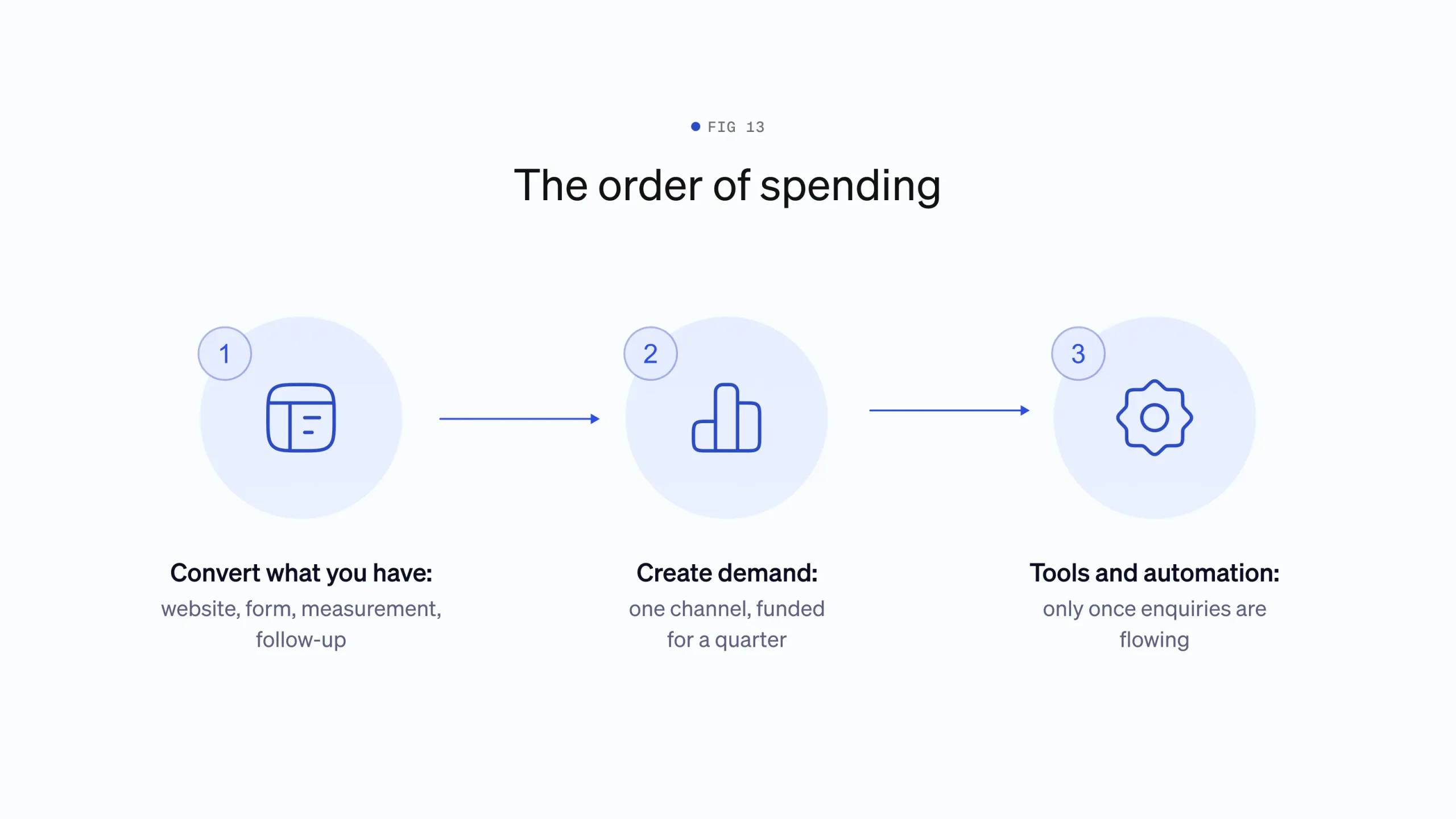
Growing the system, and what changes next
The signal to move beyond the simple system is that follow-up stops fitting in one person’s head. A prospect waits a fortnight for a reply because two people each thought the other had it, and the tracking spreadsheet describes last month rather than this week. A sheet tends to fail somewhere past 20 to 30 open conversations. Before that point, adding machinery gives you more places to look at zero. After it, leads go cold for administrative reasons.
The intermediate system adds offers for people who are not ready to buy, and a CRM to keep the promises. Where the simple system has one offer aimed at the buyer who is ready now, the intermediate system adds one for each earlier stage, each with its own short email sequence. The CRM records every contact with its source, shows open conversations by stage, and chases next actions. Stages are defined by facts that happened, a call booked, a proposal sent, not by moods like “interested”. Marketing and sales write down, on one page, what makes a lead qualified. Automation extends to delivery and reminders and no further.
A single funnel stops describing a business once buyers arrive by more than one route. A mid-sized SaaS company commonly runs four at once: self-serve trial, sales-led demo, partner-sourced deals and expansion within existing accounts. Each route has its own pages, follow-up and numbers, and averaging them produces figures that describe none of them. In the product-led route, the lead definition shifts from what someone read to what someone did in the product. The website, meanwhile, serves a buying committee of six to ten people, so it needs a security page, a plain pricing page and documents a champion can forward to meetings the vendor never attends.
Intent data divides into a kind worth everything and a kind worth testing. First-party intent, the behaviour recorded on your own site and in your own product, is free and observed directly. Third-party intent, bought signals claiming to show which companies are researching your category elsewhere, is priced in five figures a year, and no independent audit of its accuracy exists. Exhaust the first before trialling the second, and treat account-based programmes as suitable only where deals are large enough that a named list of targets covers the growth plan.
What is observable in 2026 is narrower than the commentary suggests. Buyers complete more of the evaluation before contact. AI assistants answer comparison questions from whatever vendors have plainly published, and a small but present share of referral traffic now comes from them. A growing share of searches ends without a click to any website. Cross-site tracking keeps degrading, and auction-priced advertising keeps rising against stable inventory. All of this can be seen in ordinary analytics and sales calls today.
What is speculation should be labelled as speculation. Whether assistants become the main discovery channel for B2B, and on what timescale, is an open question, and confident forecasts are guesses. The response does not depend on the answer: publish plain, verifiable answers to buyers’ questions, collect data people hand over knowingly, and keep the email list, the case studies and the content library in assets you own rather than rent.
The full treatment of this stage is a separate article. How lead generation works for SaaS and multi-journey businesses adds what this summary leaves out: a five-stage pipeline table with exit criteria, the rules for timing the handover from product to salesperson, the choice between free trial, freemium and demo, a worked three-route example for a software company charging ₹2,400 per user per month, and a practical response to each of the shifts above.
Common questions
These are the questions the studio is asked most often when a company starts on this work.
A lead is a person who has given you a way to contact them and shown some sign of interest in what you sell. The definition matters less than having one that marketing and sales both agree on and have written down. Most companies that argue about whether their lead generation works are arguing about the definition rather than the result.
Four is a reasonable starting point for most small companies: name, company, work email, and a message box. Every extra field is a reason for someone to stop, and anything you can ask on the first call does not need to be on the form. Budget dropdowns, industry pickers and company-size selectors are the fields most often added and least often worth their cost in completions.
Set the budget by clicks rather than by currency. A campaign needs roughly 30 clicks a week before you can tell a poor campaign from a quiet one, so multiply your expected cost per click by 30 to find the weekly minimum. Below that, you will be reading noise, and the most common mistake is stopping a campaign after four days on the basis of eleven clicks.
Paid search can produce enquiries in the first week, though it takes four to six weeks before the data means anything. Organic search takes months rather than weeks, and for a new site six to twelve months is a fair expectation before it contributes steadily. Email nurture works on the length of your sales cycle, so a six-month cycle means a six-month wait before you can judge it.
Within one working day, and the same hour where you can manage it. The value of speed is less about a psychological effect than about the fact that a person who has enquired with you has usually enquired with two others on the same afternoon. An automatic acknowledgement within a minute buys you time, but it does not replace a person replying.
It is, in India, the Middle East, Latin America and South East Asia, where a WhatsApp message is often the normal way to contact a supplier. Click-to-WhatsApp advertising run from Meta sends people into a conversation rather than a form, which removes friction and changes what you can capture. The main risk is that the conversation lives on one person’s phone and never reaches a shared record.
They send fewer visits and more pre-qualified buyers, because someone who arrives after an assistant has recommended you has already done the comparison. Google has stated that its AI features are grounded in its core Search ranking systems, so appearing in them depends on ordinary search visibility rather than on any separate technique. Files such as llms.txt are not used by Google Search.
There is no benchmark worth quoting, because published cost-per-lead figures vary by more than an order of magnitude between industries and countries. Work it out from your own numbers instead: take the value of a closed deal, multiply by the share of leads that close, and that is the most a lead can be worth to you. Anything below that is affordable, and the gap between the two is your margin.
Do it yourself until you have a process that works, then hand over the running of it. Hiring before the process exists means paying someone to invent one while learning your business, which is the most expensive order to do it in. The exception is a technical setup, such as conversion tracking or a first campaign structure, where a few hours of help prevents months of unusable data.
Replying to an enquiry is a different matter from adding that person to a marketing list, and the two need separating on the form. Under the UK and EU GDPR, answering the question someone asked is generally covered, while sending them unrelated marketing is not, and a separate unticked box is the usual way to handle it. India’s Digital Personal Data Protection Act requires notice and consent at the point of collection. This is a description rather than legal advice.
The homepage will do while you are running one offer and little traffic. A dedicated landing page becomes worth building once you are paying for the visit, because the page can then answer the exact search that brought the person and leave out everything else. The test is whether the headline can echo the words the visitor typed.
When you can no longer remember where each conversation stands, which for most companies is somewhere between twenty and fifty open enquiries. A spreadsheet handles less than that and handles it well. Buying software before you have a defined set of pipeline stages produces an expensive record of the same confusion.
The short version
Lead generation is four things working together, and a company that is not producing enquiries is usually missing one of them rather than doing all four badly. Find the missing part before spending on any of the others. An offer nobody wants cannot be fixed with a larger advertising budget, and a page that converts well cannot help if nothing reaches it.
Build the smallest version that works before adding to it. One page, one offer, one channel and one follow-up sequence will tell you more in six weeks than a full stack of software will tell you in a year, because it has few enough moving parts that you can see which one is failing. Add the second channel once the first produces something you can count, and add software once you have a process that the software would carry rather than a process you hope it will supply.
Measure the things that connect to money and accept that some of what works will not show up in any report. Cost per qualified lead, the rate at which leads become opportunities, and the time between first contact and a signature are the figures that survive a conversation with whoever holds the budget. Traffic, impressions and rankings are not, and a company that reports them in place of the others is usually reporting them because the others are not good.
What changes in 2026 is where the research happens, not what persuades. Buyers arrive later, better informed, and having already compared you with two other suppliers through a tool that never sent you a visit. The response to that is the same work done more plainly: state what you do, publish what it costs, show evidence a stranger can check, and answer the questions buyers ask before they ask them. That is readable to a person and to the systems now reading on a person’s behalf.
A small thing and a big thing
One small thing to fix on your website today, and one big thing to learn that gets you more leads.




 Your information is
safe with us. No spam.
Your information is
safe with us. No spam.